By HiPipo Money
Africa’s digital finance revolution has transformed millions of lives over the last decade.
Mobile money expanded access to financial systems at extraordinary speed. FinTech platforms lowered barriers that had excluded millions for generations. Women who once operated entirely outside formal banking ecosystems suddenly gained the ability to:
- save digitally,
- receive payments,
- access remittances,
- and participate in mobile commerce directly from their phones.
But beneath the progress, another divide remains deeply visible. The mobile gender gap.
Across many African countries, women are still less likely than men to own smartphones, access mobile internet, or use advanced digital financial services independently. The gap may appear technological on the surface, but its consequences are economic, social, and deeply structural.
Because in today’s digital economy, the smartphone is no longer simply a communication device.
It is infrastructure. It is the bank branch. The wallet. The marketplace. The business platform. The classroom. The gateway into opportunity itself. And when millions of women remain partially disconnected, entire economies lose productive capacity.
For years, financial inclusion conversations focused primarily on account ownership. Could women open accounts? Could they join mobile money ecosystems? Could they access formal financial services?
Those questions mattered enormously. But the next challenge is more complex. Can women fully participate in digital economies once access exists? In many cases, the answer remains incomplete.
A woman may technically own a mobile money account while still lacking:
- a personal smartphone,
- affordable internet access,
- digital confidence,
- or independent control over the device itself.
This weakens meaningful participation significantly.
Affordability remains one of the largest barriers. For millions of low-income households, smartphones are still expensive assets. Where resources are limited, purchasing decisions are often shaped by both financial pressure and social norms. In many households, men receive priority access to smartphones while women rely on shared devices, borrowed phones, or limited supervised access. This changes the nature of digital participation completely.
A digital account becomes far less empowering when access to the device itself remains uncertain. The issue is not only connectivity. It is autonomy. Data affordability creates another layer of exclusion.
Even where smartphones exist, internet access can remain expensive relative to income levels. Women managing households or operating microbusinesses often prioritize food, healthcare, transport, school fees, and family emergencies before purchasing mobile data.
Yet modern digital ecosystems increasingly depend on:
- mobile apps,
- online onboarding,
- QR payments,
- digital marketplaces,
- and internet-based services.
This means smartphone and connectivity affordability are now directly tied to financial inclusion itself. The danger is becoming increasingly clear.
Africa’s future digital economy could unintentionally deepen inequality if advanced digital services become concentrated among populations with stronger digital access and confidence.
This is why affordable smartphone initiatives are becoming increasingly important across the continent.
Governments, telecom operators, FinTechs, and development institutions are exploring:
- low-cost smartphones,
- device financing,
- pay-as-you-go handset models,
- subsidized connectivity,
- and bundled digital-finance ecosystems
designed to lower entry barriers.
The logic is simple. Without devices, inclusion slows dramatically.
Some FinTech ecosystems now integrate smartphone financing directly into financial services models, allowing users to pay gradually over time instead of requiring large upfront purchases. This matters especially for women entrepreneurs operating small businesses with irregular cash flow.
A flexible payment structure can turn smartphone ownership from an impossible expense into an achievable economic investment. And once connected, the effects can compound rapidly. Digital skills training is equally important. Access alone does not create confidence.
Millions of first-generation digital users still struggle with:
- mobile apps,
- online fraud,
- PIN security,
- digital savings,
- transaction verification,
- and mobile lending systems.
Women are often disproportionately affected because educational and technology-access gaps historically limited exposure to digital tools in many communities. This means inclusion efforts must go beyond infrastructure. They must build capability too.
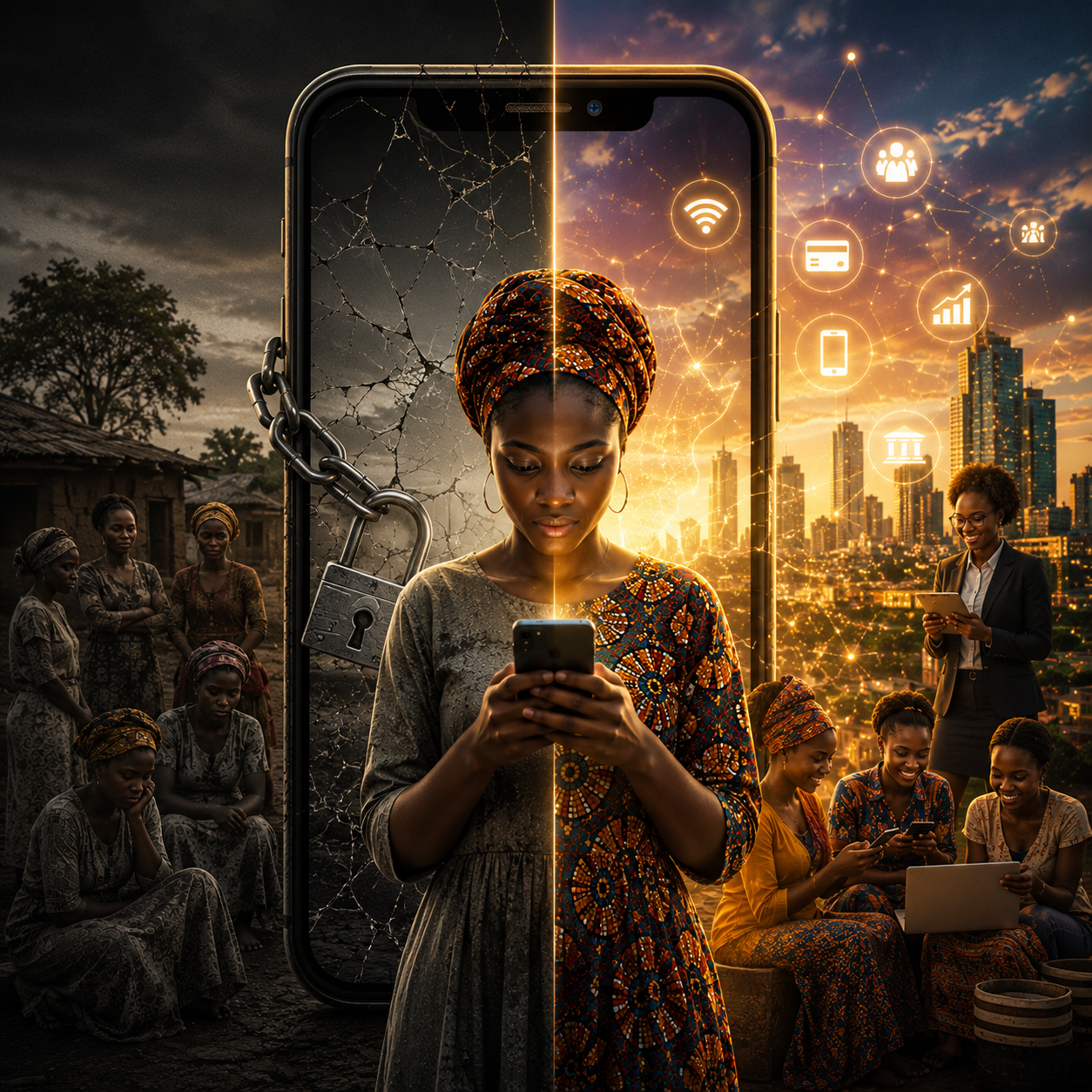
A woman who owns a smartphone but fears using digital financial services independently remains partially excluded from the digital economy. Confidence is infrastructure too.
Community-based digital literacy programs are increasingly helping close this gap. Across parts of Africa, women-focused initiatives now combine:
- mobile money education,
- smartphone onboarding,
- fraud awareness,
- digital business skills,
- and financial literacy training.
The impact often extends far beyond finance itself.
A digitally confident woman may also gain access to:
- e-commerce,
- telemedicine,
- online learning,
- agricultural information,
- digital government services,
- and broader entrepreneurial ecosystems.
Digital literacy therefore becomes an economic multiplier. Gender-sensitive financial products are also becoming increasingly important. Historically, many financial systems were designed around assumptions that did not fully reflect women’s economic realities. Traditional banking often favored:
- salaried employment,
- formal income structures,
- rigid repayment schedules,
- and conventional collateral systems.
But millions of African women operate within:
- informal trade,
- seasonal income cycles,
- caregiving responsibilities,
- and microenterprise environments.
Digital finance platforms increasingly recognise that women require products designed around actual usage realities rather than inherited banking assumptions.
This shift is driving growth in:
- micro-savings tools,
- women-focused insurance,
- flexible digital credit,
- savings-group integration,
- merchant platforms,
- and low-value transaction ecosystems.
The strongest financial products are not merely digital. They are contextual. Women-led FinTech innovation is helping accelerate this transition too.
Across Africa, more women are participating directly as:
- founders,
- FinTech executives,
- mobile money agents,
- digital entrepreneurs,
- and ecosystem builders.
That representation matters because systems become more inclusive when women help shape them directly.
The future digital economy cannot fully serve women if women remain underrepresented inside the institutions building that future.
There is also a deeper macroeconomic story unfolding quietly beneath the surface. Closing the mobile gender gap is not only about fairness. It is about growth.
Women already drive enormous portions of:
- household spending,
- agriculture,
- caregiving economies,
- informal trade,
- and SME activity across Africa.
When women gain stronger digital access, economies gain:
- more productive businesses,
- broader financial participation,
- larger digital marketplaces,
- stronger household resilience,
- and deeper economic visibility.
The gains ripple across entire systems.
This is why closing the mobile gender gap increasingly sits at the centre of conversations around:
- financial inclusion,
- digital transformation,
- FinTech innovation,
- SME growth,
- and economic modernisation.
Yet progress requires ecosystems, not isolated interventions. Affordable smartphones alone are not enough. Connectivity alone is not enough. Accounts alone are not enough.
The system must work together:
- affordable devices,
- reliable electricity,
- low-cost connectivity,
- trusted identity systems,
- interoperable payments,
- digital literacy,
- cybersecurity,
- and gender-sensitive financial design.
Without those layers working together, inclusion remains fragile.
For HiPipo Money, closing the mobile gender gap represents one of the most important economic opportunities shaping Africa’s future.
The continent’s digital transformation cannot reach full scale while millions of women remain partially disconnected from the infrastructure powering modern commerce and finance.
This aligns strongly with broader conversations around:
- women’s empowerment,
- digital literacy,
- FinTech innovation,
- mobile money,
- affordable connectivity,
- interoperable systems,
- and inclusive growth championed through ecosystems such as Women in FinTech, Include Everyone, the Digital Impact Awards Africa (DIAA), and wider digital transformation movements across the continent.
Because ultimately, the smartphone is no longer just a device.
For millions of African women, it is becoming the key to participation in the future economy itself.
A trader accessing digital markets. A mother managing household finances independently. A student learning online. A rural entrepreneur building a business digitally. A woman gaining economic confidence through technology she can finally control herself.
Most people still discuss smartphones as consumer technology. But across Africa, they are increasingly becoming tools of economic inclusion, visibility, and power.