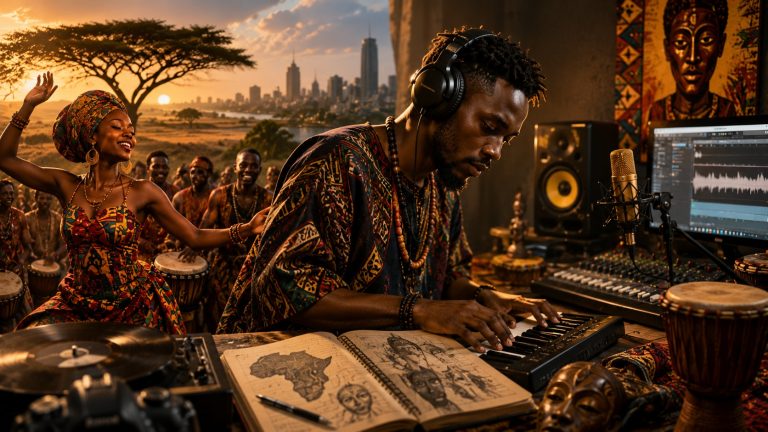
In an era where algorithms reward speed, virality, trends, and volume, one painful truth continues to haunt the African music industry: too many creators have forgotten that music is art before it is content.
Music was never meant to be noise. It was never meant to be rushed. It was never meant to exist merely to fill timelines, chase charts, imitate trends, or harvest temporary attention from social media platforms. Music, at its purest form, is one of humanity’s deepest artistic expressions, a living language of emotion, imagination, beauty, memory, rebellion, healing, spirituality, identity, and truth.
And like every great form of art, music demands originality.
Art is the deliberate creation of beauty, meaning, feeling, and imagination through skill. That definition does not change because the medium is sound. A song is not exempt from artistry simply because it can trend online for seven days. A beat is not meaningful simply because it is loud. A video is not creative simply because it is expensive.
True music must communicate something.
Every artist must constantly wrestle with difficult questions:
What am I creating?
What emotion am I carrying?
What truth am I expressing?
What feeling will this leave behind?
What makes this uniquely mine?
Without those questions, music loses its soul.
Across Africa and beyond, too much modern music production has become mechanical. Songs are increasingly assembled like factory products, fast, repetitive, trend-driven, and emotionally empty. Producers recycle sounds. Artists mimic flows. Videos copy foreign aesthetics. Entire creative careers are built around imitation instead of invention.
But history never remembers copycats for long.
The world remembers creators who dared to sound different. The artists who introduced new emotions. The musicians who disrupted existing sounds. The visionaries who brought their cultures, scars, joys, fears, spirituality, languages, and environments into their work.
From village drums to jazz, from reggae to Afrobeat, from traditional folk music to modern African fusion, every globally respected sound was born because someone embraced originality instead of imitation.
The greatest artists in history understood this deeply.
From Wolfgang Amadeus Mozart to Michelangelo, from Fela Kuti to Miriam Makeba, from Lucky Dube to the pioneers of modern African urban music, legendary creators became timeless because they created worlds nobody had experienced before. Their work carried identity. Their work carried courage. Their work carried emotional fingerprints that nobody else could duplicate.
That is the responsibility of every musician.
An artist must not simply perform. An artist must reveal something human.
The beauty of true music is that inspiration already surrounds us. Nature itself is artistic. The rhythm of rain. The silence of sunrise. The chaos of Kampala traffic. The laughter inside a village trading center. The heartbreak of unemployment. The resilience of single mothers. The dreams of young Africans trying to survive in difficult economies. The energy of markets. The loneliness of city life. The spirituality inside prayer. The beauty of love. The fear of failure.
These are not just life experiences.
They are raw materials for timeless art.
Great musicians observe deeply before they create deeply.
And artistry extends beyond lyrics alone. Music videos, production, instrumentation, styling, cinematography, choreography, lighting, location selection, costume design, sound engineering, storytelling, and post-production are all part of the artistic process. Every decision communicates emotion. Every detail contributes to meaning.
A truly artistic music video should feel like a visual extension of the song’s soul.
Unfortunately, many creators now operate under pressure to release quickly rather than create meaningfully. The industry rewards consistency more than craftsmanship. Musicians are often pushed to feed digital platforms instead of feeding culture. The result is a flood of disposable music that dominates briefly and disappears almost immediately.
But timeless art has never been rushed.
The painters, sculptors, architects, playwrights, filmmakers, and novelists who shaped civilizations invested enormous thought into their craft. They respected the creative process. They revised. They reflected. They experimented. They failed. They refined.
Musicians must reclaim that discipline.
Africa’s creative economy is entering a defining era. Streaming platforms, digital distribution, artificial intelligence, short-form video, and creator monetization tools are opening unprecedented opportunities for artists across the continent. But technology alone will never replace artistic depth.
The future belongs to creators who combine authenticity with innovation.
The artists who will build lasting influence are not necessarily those with the loudest marketing campaigns, but those brave enough to sound like themselves in a world full of imitation. Audiences eventually connect most deeply with honesty. They remember emotional truth. They reward originality over time.
Every time an artist suppresses their uniqueness to imitate another creator, the world loses a voice it has never heard before.
And perhaps that is the greatest tragedy in modern music.
Because every artist carries something unrepeatable within them, a perspective, a pain, a cultural memory, a dream, a vulnerability, a madness, a rhythm, a voice, a story, a spiritual imprint that nobody else on earth can recreate exactly the same way.
That uniqueness is the gift.
Music should bring out the fearless you, the emotional you, the wounded you, the hopeful you, the spiritual you, the joyful you, the confused you, the passionate you, the revolutionary you. Music should liberate expression, not imprison creativity inside trends.
Artists must stop treating music as merely a shortcut to fame or money.
Music is legacy.
It is cultural memory.
It is emotional architecture.
It is identity preservation.
It is social commentary.
It is healing.
It is resistance.
It is imagination.
It is freedom.
And above all, it is art.
So work with creators who respect the craft. Invest in professionalism. Protect originality. Create intentionally. Let beauty be heard in your sound. Let imagination be seen in your visuals. Let emotional honesty live inside your lyrics.
Because the world does not need more copies. It needs artists brave enough to create something unforgettable.