Development partners and Private Sector Foundation Uganda (PSFU) have committed to undertake joint efforts to support micro, small and medium-sized enterprises (MSMEs) to develop into large enterprises.
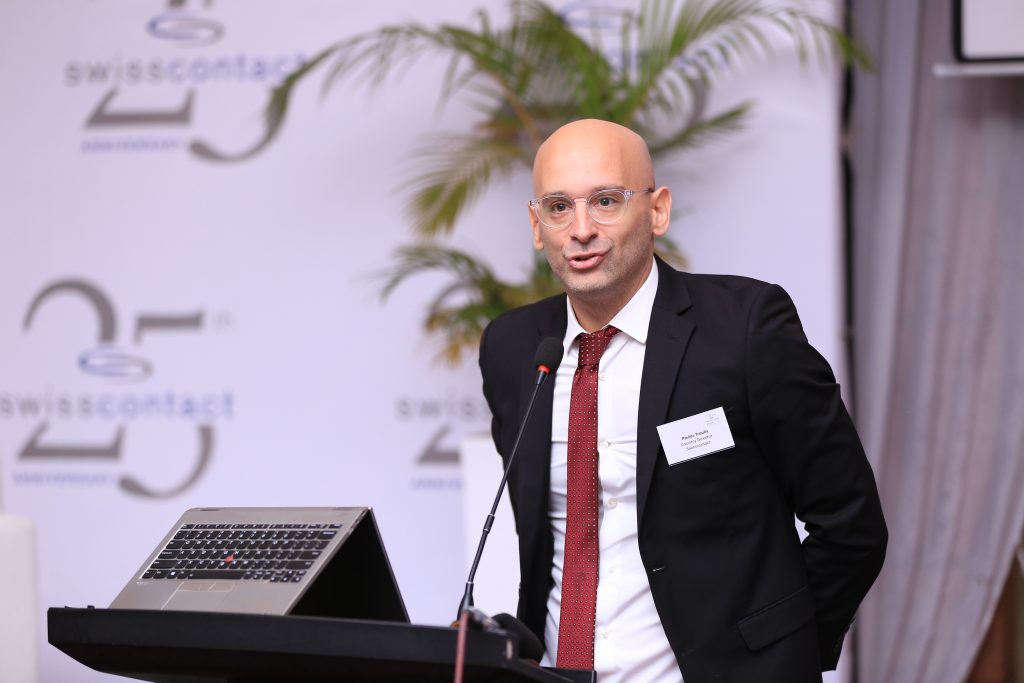
This commitment was made last week during a Private Sector-led development forum organized by Swisscontact; a development partner that is celebrating twenty-five years in Uganda.
According to Uganda’s Ministry of Finance, Planning and Economic Development, Uganda’s private sector comprises over 1,100,000 enterprises which employ approximately 2.5 million people, an equivalent of 90% of total non-farm private-sector workers. The private sector continues to be dominated by micro enterprises (93.5%), small enterprises (4.1%), and medium enterprises (2.4%).
“Up to 98 of private sector is MSMEs. Where are the large enterprises? What are we not doing right, or what must we do to support and graduate these MSMEs into large enterprises?” Pavlos Troulis, the Uganda Country Director for Swisscontact noted.
He added: “We need to be sharing much more information, aligning and supporting each other. This event is about supporting the Private Sector to achieve its objectives. It is urgent that we work together with PSFU and other partners to support the transition from MSMEs to large enterprises.”
Further, Damali Ssali, the chief programs and projects officer at PSFU called for regular engagements; pledging that PSFU would be happy to host the secretariat that would spearhead the activities to fast-track MSMEs’ growth.
“As an output and a celebration of the 25-year anniversary of SwissContact in Uganda, I would love to see us here establish as a private sector-led development platform where we can meet regularly and share information, lessons and much more to ensure the rapid growth of the private sector. As PSFU we would be happy to host the secretariat of such a platform,” Ms Ssali said.
She urged stakeholders to enhance research so as to provide evidence-based policy and advocacy position papers that will spur economic development.
“We are happy to partner with anyone who is in this space as we have access to over 3.5 million enterprises through our associations that can provide valuable data collection points,” she said. Swisscontact is an independent non-profit organization established in 1959 by the representatives of the Swiss private sector and civil society. It has in the past 25 years invested massively in Uganda in areas of Agriculture and Value Addition, along the way creating opportunities for thousands of Youth and Women.
The 2023 Digital Impact Awards Africa celebrated pioneering achievements and innovations in the digital sphere, honouring exceptional organizations and individuals who have showcased significant strides in advancing financial inclusion in Africa.
MTN Uganda & MTN MoMo took home the biggest award after being crowned as the Digital Brand of the Decade for their remarkable impact from 2014 to 2023 – the 10 years that this project has been running.
Standard Chartered Bank and Centenary Group received accolades in the Digital Brand of the Year category, with Diamond and Gold awards, respectively.
The Digital Impact Awards Africa is a platform that promotes Digital Inclusion, Financial Inclusion, and Cyber Security. The Awards recognize companies and stakeholders that are spearheading the use of digital mediums to serve communities and promote financial inclusion.
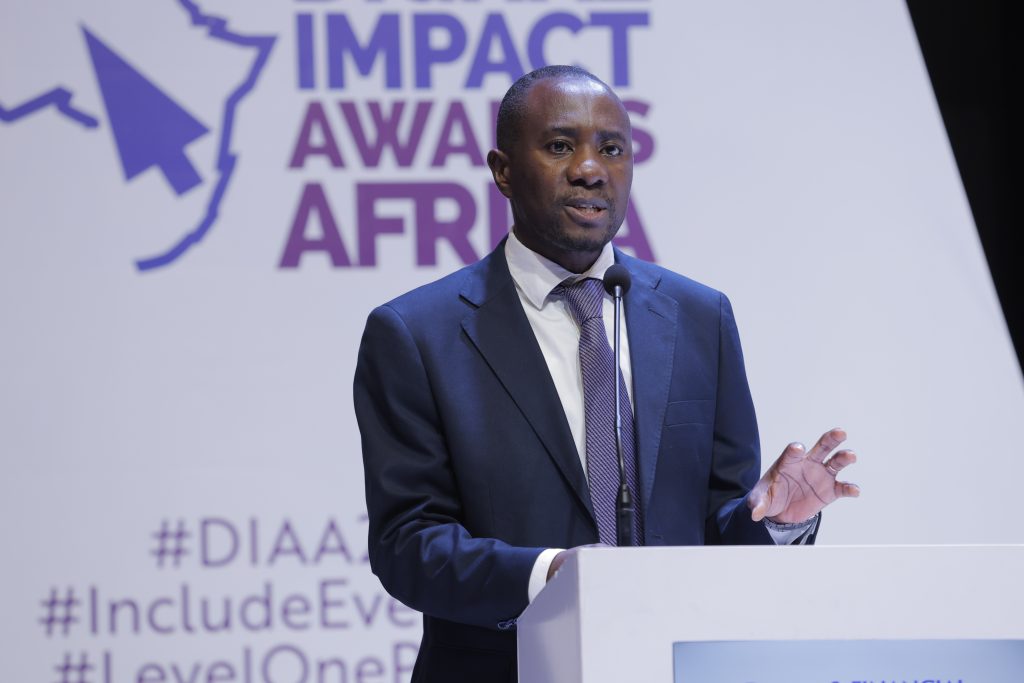
“The criteria of the nominees are always tight. Some innovators and companies have won every single year for their innovations and dedication to Digital Financial Inclusion,” Innocent Kawooya, the HiPipo CEO said.
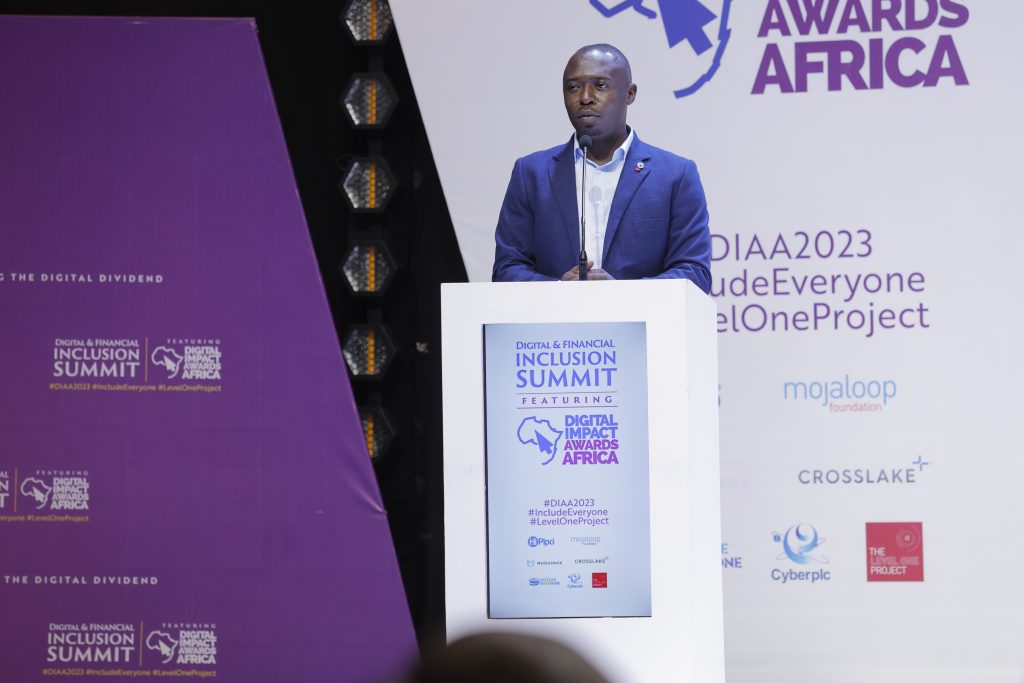
The Digital Impact Awards Africa is part of the broader Digital and Financial Inclusion Summit organized by HiPipo in partnership with Level One Project, Mojaloop Foundation, INFITX, Cyberplc Academy, Ideation Corner, and Crosslake Technologies and generously supported by the Bill and Melinda Gates Foundation.
Winners celebrated.
Hon. Joyce Nabbosa Ssebugwawo, the Minister of State for ICT applauded the winners for their contribution to developing Uganda and Africa. She challenged them to continue innovating as this is the only sure way of transforming their communities.
The accolade for CEO of the Year was bestowed upon Fabian Kasi of Centenary Bank, who claimed the Diamond award, while Richard Yego of MTN MoMo was honoured with the Gold award.
Under the category of Community Digital Empowerment Excellence, Cente Tech’s Digital Messaging Platform for Catholic Dioceses clinched the prestigious Diamond award, with Oracle Academy securing the Gold recognition.
FutureLink Technologies’ MSacco stood out in the Financial Inclusion Excellence category, while Standard Chartered Bank excelled in Digital Banking Excellence.
In the Banking Innovation Excellence arena, Post Bank’s latest Wendi Digital Wallet emerged as a frontrunner. Centenary Bank and Pride Microfinance Limited claimed top honours in Community/MFI Banking Innovation Excellence, securing the Diamond and Gold awards, respectively.
Airtel Money’s Micro Merchant earned acclaim in FinTech Innovation Excellence, while MTN MoMo triumphed in Financial Services Digital Excellence.
For Consumer Goods Digital Excellence, Movit took home the Diamond award, closely followed by Jude Color Solutions with the Gold distinction.
Utilities and Government Services Digital Excellence recognized Uganda Registration Services Bureau (URSB) with the Diamond accolade and National Water and Sewerage Corporation (NWSC) with the Gold recognition.
In the domain of Technology Services Digital Excellence, Comviva emerged as the standout performer.
Below is the full list of all winners.
Community Digital Empowerment Excellence.
Digital Messaging Platform for Catholic Dioceses by Cente Tech – Diamond
Oracle Academy – Gold
Financial Inclusion Excellence.
MSacco by FutureLink Technologies
Digital Banking Excellence.
Standard Chartered Bank
Banking Innovation Excellence.
WENDI Digital Wallet by Post Bank
Community/MFI Banking Innovation Excellence.
Centenary Bank – Diamond
Pride Microfinance Limited – Gold
FinTech Innovation Excellence.
Micro Merchant by Airtel Money.
Financial Services Digital Excellence.
MTN MoMo
Consumer Goods Digital Excellence.
Movit – Diamond
Jude Color Solutions – Gold
Utilities and Government Services Digital Excellence.
During the 2023 Digital and Financial Inclusion Summit, industry stakeholders noted the need for improved infrastructure to improve business operations and counter the surging instances of fraud.
Held at Kampala Serena Hotel, the 2023 Digital and Financial Inclusion Summit was organized by HiPipo in partnership with Level One Project, Mojaloop Foundation, INFITX, Cyberplc Academy, Ideation Corner, and Crosslake Technologies and generously supported by the Bill and Melinda Gates Foundation.
Sanyu Gila, who graduated from university in 2015, found herself unable to secure formal employment. This led her to explore the potential of the mobile money agent business as an alternative means of livelihood.
“Over the years, I have grown and scaled this business, but it hasn’t been without challenges. Fraud prompted the closure of some outlets I had opened. Inexperienced employees posed vulnerabilities to my business resulting in big losses. The declining telecom commissions, taxes, and network issues have also eroded customer trust in some of the products,” Gila shared.
Similar sentiments were echoed by Aturinda Tryphine and Gloria Mirembe; also, Mobile Money Agents during the summit, which focused on ensuring the safety of customers’ funds and platform security.
The summit fostered discussions essential for advancing digital and financial inclusion across Africa.
“We face capital limitations. Sometimes you forego bigger transactions because you do not have enough float. As a result, you miss out on commission as well as customers who may not come back to you,” Gloria said.
Hon. Joyce Nabbosa Ssebugwawo, the Minister of State for ICT, stressed the necessity of enhancing Fintech infrastructure to safeguard customers and agents.
“HiPipo has championed digital financial inclusion excellence. As we navigate this era, our efforts should extend beyond to empower underserved communities. FinTech has reshaped business, but the escalating cyber threats highlight the need for cybersecurity,” she remarked.
National Payment Switch taking shape.
The anticipated launch of a national switch in payment processing in the near future aims to revolutionize financial transactions, enhance liquidity management, and streamline Anti-Money Laundering and Countering the Financing of Terrorism capabilities. This initiative is forecasted to strengthen cyber surveillance while significantly reducing transaction costs for retail digital payments such as mobile money users.
Andrew Kawere, the Deputy Director of the National Payments Systems at the Bank of Uganda, said the primary objective of the national switch is to act as a catalyst for efficiency and interoperability, promoting standardized practices in financial transactions.
“We envisage the national switch being delivered as a safe and affordable public good that supports innovation. Digital transformation has been proven to have a positive impact on financial inclusion by providing an avenue for the disadvantaged to access financial services and to participate in the money economy,” he said.
The summit gathered key stakeholders driving digital and financial service adoption across Africa, including policymakers, young entrepreneurs, and innovators.
Dr. Warren Carew, Managing Director at INFTX, noted the challenges in developing an interoperability system.
“Addressing fraud in mobile money platforms requires identity infrastructure. Focusing on interoperability can reduce barriers to financial services,” Carew noted.
Innocent Kawooya, the HiPipo CEO, applauded the project’s partners for their thoughtful commitment to enhancing digital and financial inclusion across Africa.
He noted that through partnerships and deliberate support, a lot of ground has been covered with millions of end-users onboarded on to the digital and financial inclusion train in the last decade. Nonetheless, he said that much more effort is needed for complete inclusion to be achieved.
In a move to make Uganda’s Start-ups profitable and attractive to investors, Business Stakeholders drawn from across the country are working against time to deliver a National Start-Up Policy for the Country in 2024.
The Policy that will address the existing constraints affecting the start-up ecosystem in Uganda is being spearheaded by Private Sector Foundation Uganda (PSFU), supported by the Mastercard Foundation and coordinated by the Ministry of Trade Industry and Cooperatives.
Speaking during a technical team roundtable meeting held in Kampala this week, Apollo Muyanja Mbazzira, the PSFU Lead Firm Structure (LFS) Project Director noted that on conclusion, the national start-up policy will streamline small and young businesses’ operations.
“Tunisia has one of the best start-ups policies and they are doing well. When you go to Cairo, a similar thing is happening and bearing results. Beyond start-up policy, can we position Uganda as a benchmark of start-ups regionally and across the continent,” Mr Muyanja said, adding;
“Uganda is a home of over 5 million refugees, showing our welcoming nature. If we can welcome businesses in the same way we welcome refugees, then we shall thrive as a country. This is our thought at PSFU and we have shared it widely. We need to position ourselves and go after the available opportunities across the continent.”
According to Keneth Twesigye, the Lead Policy at Startup Uganda, this ACT, when concluded and implemented will shield Ugandan Entrepreneurs from unfair competition.
“Several multi nationals come here and get several business facilitation privileges yet not so much is done for local start-ups. We believe that with this ACT, Ugandan start-ups will have a chance to compete favorable on the market as it will not only establish what they need but also how to get support.
Keneth Twesigye, the Lead Policy at Startup Uganda, addressing the media at Kampala Serena Hotel.
A Startup can be defined as new entity of at least 12 months old that applies innovation or technology to develop a disruptive process, product or service that is scalable or has growth potential to commercialize. In the context of Uganda, such a business must meet some of this criterion; has a temporary management structure, spends part of its budget on research and development, is Ugandan owned by majority and is locally incorporated in Uganda.
Well as Uganda has several start-ups employing hundreds of Youth and Women, these businesses continue to be hampered by low innovation, stagnated growth, low startup scalability, low startup sustainability, and unfair competition. It is these evils that the National Start Up Policy comes to cure.
“This is not an activity. It is a private sector initiative, we need to own it and make it work. The start-up policy will build on all our other interventions. The Policy is urgently needed. It is extremely critical as it will help protect interests of our local businesses,” Arnold Byaruhanga, a representative of the Mastercard Foundation noted.
Relatedly, Hon. Boniface Okot, the Youth MP for Northern Uganda a few months ago presented a Start-Up ACT as a private bill in the Uganda Parliament. At that time, he noted that Start-up Act is one of the progressive legislative interventions and incentives for young people to actively participate in matters of socio-economic transformation.
The Ugandan commuter can now replace cash payments in commuter buses with a simple Tap and Go card; a smarter, more convenient and certainly more future-leaning way to pay transport fare in and around the city and eventually the country.
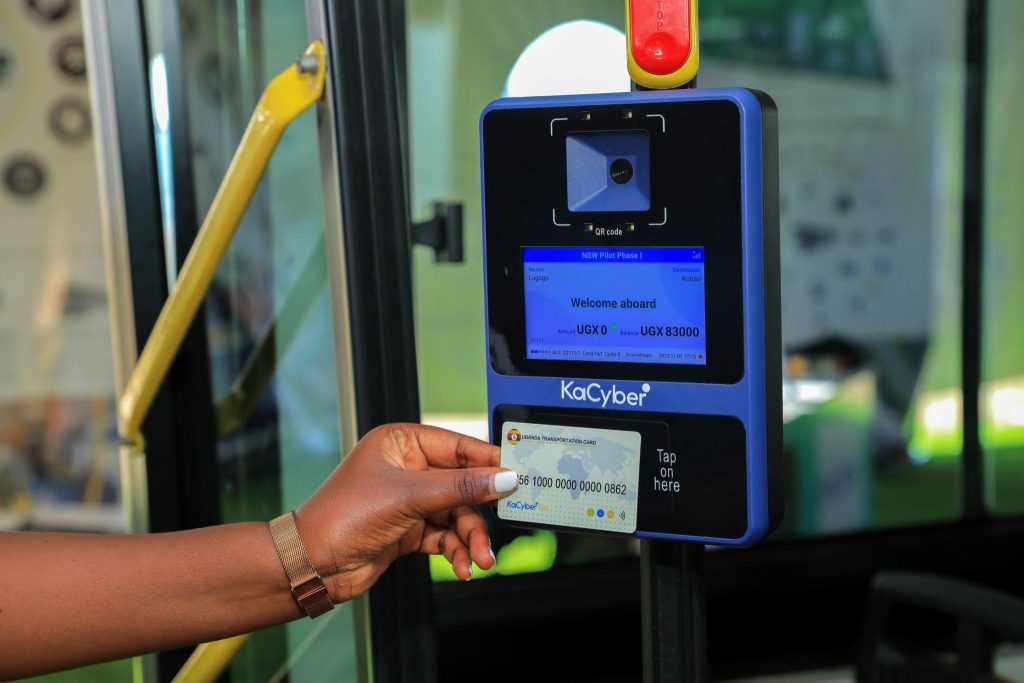
Launched at this year’s National Science Week, the KaCyber Go Card, Uganda’s first contactless transport card is an initiative of KaCyber Technologies, a transportation technology company, in partnership with Kiira Motors Corporation with facilitation from the Government of Uganda.
The Transport card was launched at the closing ceremony of the just concluded National Science Week 2023 by the Prime Minister, Rt. Hon. Robinah Nabbanja. In her remarks, the Prime Minister, who had made the specific request to KaCyber Technologies one year earlier at the same event to build a cashless payment system for public transport, “similar to the one in London”, was elated to see “science at work”.
Piloted and tested on the Kiira Motors’ Kayoola EVS buses, which were also a crowd pleaser during the event, the card works in tandem with a ticketing validation machine that is installed inside the bus at both entrances/exits. To pay the bus fare, or transport, as we call it, one simply places their card within proximity of the machine and the amount for the journey is automatically deducted. The amount deducted as well as the balance on the card is displayed on the screen during every transaction so that the passenger knows exactly how much they’ve been charged.
To pay their transport fare, one can load as much or as little money as they wish on their KaCyber Go card using mobile money or from their bank account.
Card users can manage their accounts online via kacyber.com or on the KaCyber Go App, allowing them to monitor transactions, check balances, and view journey histories.
In case of loss or damage, users can easily obtain a replacement card, often with the same balance and travel history as the original card.
Commuters will find using the card simple and painless because it is designed with an inbuilt chip, that is no less remarkable than that used in the UK Oyster or US Metro Cards and is enabled by internationally recognized ISO I4443 Type A Near Field Communication technology (NFCA) which means the user doesn’t need have to tap their card directly on to the ticketing validating machines but can pay by simply placing the card the machine’s proximity to enable the transaction.
With great technology and digitalization, however, comes consumer anxiety but KaCyber has also built into the cards multiple security layers to ensure the card’s integrity and user privacy and employs fraud detection algorithms to identify and flag suspicious transactions, protecting users from fraudulent activities.
This smart, digital, and contactless payment technology solution changes the game for commuters and bus operators and updates and breathes new life into Uganda’s transport industry in a way that is long overdue.
For the commuter, the prepaid card allows for planning and tracking of transport expenses and eliminates the often-irritating scuffles for ‘change/balance’ with conductors during rush hours where one has neither the time nor the patience for it.
Innocent Orikiiriza, the Founder and CEO of KaCyber Technologies, believes that this is yet another giant leap towards digitization and overall modernization of Uganda’s transport sector and definitely an advancement that will ease public transportation for commuters and operators alike.
For the operators, this digital payment solution promises to dramatically increase the efficiency of revenue tracking, minimizing the income leakages that come with entrusting collections solely to conductors. It also eliminates human error and theft and will thus guarantee increased profitability.
The immediate rollout of the KaCyber Go Card will be on Kiira Motors’ first 20 Electric Kayoola Buses slated to operate in Kampala and Jinja. It is expected that usage will then eventually extend to commuter trains, government ferries, inter-city buses and even taxis.
This digitized ticketing and payment solution mounted on the eco-friendly Kayoola EVS electric buses that are the first of their kind to be produced in Uganda and Africa aren’t just a coincidental combined achievement for Uganda but a deliberate part of the government’s initiative towards modernization as outlined in Digitalization Transformation RoadMap and Transport Masterplan.
KaCyber’s contactless Card Payment Technology has been developed following the receipt of an innovation grant of UGX 433,000,000 (Four hundred and thirty-three million Uganda Shillings only) from the Science, Technology and Innovation Secretariat – Office of the President as part of FY 22/23’s National Research and Innovation Call geared at supporting Innovation for Fast Tracking Value Addition and Industrialization.
The Ugandan government’s ultimate goal with this national transport master plan, as the Minister of Works and Transport, Gen. Edward Katumba Wamala says, is to foster economic growth and enhance the living conditions of citizens.
The Kiira Motors Corporation Partnership with KaCyber Technologies is a step forward in setting Uganda’s cities on the path to becoming one of the Cities of the Future that National Geographic envisions to be actualized by 2050 but more importantly an important action point towards achieving the Sustainable Development Goals.
About KaCyber Technologies
KaCyber Technologies is a Ugandan mobility technology company that is building robust digital ticketing and payment systems to empower public transport operators and consequently eliminate friction from commuting on public transport vessels including buses, trains, and ferries.
KaCyber has successfully processed over 11 million travel tickets, both on roads and railways, with a total worth of $54 million since its inception.
Private Sector Foundation Uganda (PSFU) and the Mastercard Foundation have facilitated the creation of over 5,000 dignified jobs for Uganda’s youth through Newman Foods Limited.
Speaking during a tour of the facility in Konge Central, Nakawuka, Nasser Segujja, founder and CEO at Newman Foods said the support from PSFU helped the company to gain immense trust within the market.
“The moment PSFU and Mastercard came on board, we earned a lot of trust in the market. PSFU has organized us and built our capacity. Now, many companies are approaching us for business,” he said.
Newman Foods Limited’s story began in 2013 from a rented house in Makindye, a Kampala suburb. It primarily focused on exporting fresh foods and vegetables to various European countries, including the United Kingdom, Germany, and Switzerland. Their export portfolio included a diverse range of products, such as green peppers, garden eggs, matooke, sweet potatoes, and sugar.
During their export operations, a critical realisation dawned upon the team. They observed that local farmers were incurring huge losses, particularly with chili production.
Recognising an opportunity and a pressing need, they decided to pivot their business by adding value to chili and hot peppers.
“Our association thought we were suitable to take up the opportunity with PSFU. We shared our dream and story and they gave us a chance. They loved the speed at which we had grown without any financing or loans from the banks,” he said.
Brenda Ankunda, an Investment specialist focusing on Crops at PSFU, praised Newman Foods Limited’s determination. She said while they initially operated in a limited space, the team demonstrated potential to grow the business.
She said the partnership between PSFU and Newman Foods Limited was forged in 2021, with a specific goal in mind, to employ 5,220 young individuals in the hot culture value chain. At the time, the company employed a modest workforce of approximately 70 people, far from its ambitious target.
“In just one year, they had reached the target and surpassed it by more than 200 young people being employed. They have managed to expand their market share from 30% to 35% and grow the market locally, regionally and internationally,” she said.
Damali Ssali, the Chief Programs and Projects Officer at PSFU said the support has helped the company improve its production as well as expand job opportunities for the youth.
“The Lead Firm Structure program supports businesses that are already established. For Newman, we built the capacity of its outgrowers. They needed people to grow the chili, and Irish potatoes so that they can be able to manufacture their products,” she said.
The Lead Firm Structure Project’s ultimate goal is to create dignified and fulfilling work for young women and men. Since its launch in 2019, the LFS project has so far mobilized 137,077 Ugandan Youth and managed to transit over 100,000 Youth into meaningful and dignified work, whilst targeting to create at least 300,000 jobs by 2025.