By John Kennedy Ssebadduka
The final whistle has blown on one of the most dramatic Premier League seasons in modern memory.
A campaign that began with uncertainty ended with redemption, resurrection, heartbreak and survival. From Arsenal finally reclaiming the English crown after more than two decades of waiting, to Manchester United’s remarkable revival under Michael Carrick, Chelsea’s self-inflicted collapse, and Tottenham Hotspur’s flirtation with disaster the 2025/26 season delivered a football story few could have scripted.
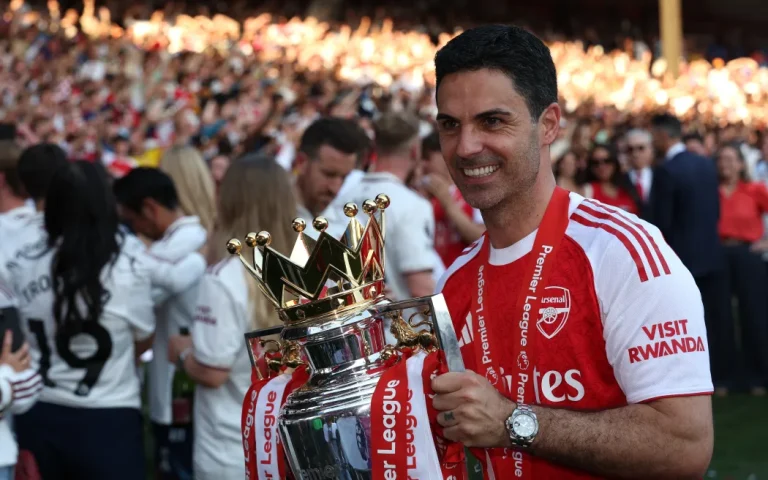
Yet above everything else stood one undeniable reality: Arsenal were champions of England.
Not because rivals failed. Not because fortune smiled upon them. But because they became the best team in the country.
Arsenal: The Psychology of Champions
For years, Arsenal supporters lived on memories. The Invincibles. Highbury. Wenger. Henry. Vieira. Bergkamp. Every season carried hope, but hope often ended in disappointment. They challenged. They improved. They rebuilt. They came close. But the trophy always slipped away.
This time was different.
Arsenal entered the season with unfinished business and emerged with complete authority. Their triumph was built on foundations stronger than emotion alone. While previous Arsenal teams often relied heavily on attacking brilliance, this side mastered the less glamorous art of championship football: defensive control, tactical discipline and mental resilience.
The numbers tell part of the story.
Arsenal possessed the league’s most reliable defensive unit. Their back line consistently suffocated opponents, turning narrow leads into victories and difficult away fixtures into manageable assignments. Clean sheets became routine. Defensive transitions became automatic. Mistakes became rare.
But statistics alone cannot explain why Arsenal lifted the trophy.
Their greatest strength was psychological maturity.
Previous Arsenal sides often played as if they needed perfection. This Arsenal played as if they expected adversity. They no longer panicked after setbacks. They no longer collapsed under pressure. They learned how to suffer. They learned how to win ugly. Most importantly, they learned how champions think.
Arteta’s Transformation: From Apprentice to Architect
At the centre of this transformation stood Mikel Arteta.
Once criticized as an inexperienced apprentice attempting an impossible rebuild, Arteta has now completed one of football’s most remarkable managerial projects. He inherited instability, division and uncertainty. What he leaves this season is a championship-winning machine capable of competing with Europe’s elite.
The manager’s greatest achievement may not be tactical. It may be cultural.
He transformed Arsenal from a club haunted by its past into one creating its future.
The squad reflected that identity perfectly. David Raya provided reliability between the posts. Declan Rice became the emotional heartbeat of the team. Bukayo Saka continued evolving into one of Europe’s defining players. Around them emerged a collective capable of sharing responsibility rather than depending on one superstar.
Every champion requires talent. The greatest champions require belief. Arsenal possessed both.
United’s Resurrection: The Carrick Effect
Yet while Arsenal were writing a story of glory, another giant was quietly scripting one of football’s most unexpected recoveries.
Manchester United appeared destined for another season of frustration. Results deteriorated. Confidence evaporated. Expectations collapsed. Eventually the club made the decision that changed everything: parting ways with Ruben Amorim.
The move initially looked desperate. Instead, it became transformative.
Michael Carrick’s appointment restored simplicity where complexity had taken hold. United rediscovered balance. Players looked liberated. The atmosphere around the club changed almost immediately. Results improved. Confidence returned. Momentum followed.
What seemed impossible midway through the campaign became reality by season’s end. Manchester United surged up the table to secure a UEFA Champions League place.
The turnaround served as a reminder that football remains a sport driven as much by psychology as tactics. Carrick did not need a revolution. He needed clarity. Under his leadership, United rediscovered identity, organization and belief.
For a club accustomed to operating among Europe’s elite, Champions League qualification represented more than a top-four finish. It represented restoration.
Chelsea’s Cautionary Tale: When Talent Isn’t Enough
If United became the season’s great comeback story, Chelsea became its most painful cautionary tale.
The irony was impossible to ignore. The newly crowned FIFA Club World Champions possessed one of the world’s most talented squads. The resources were immense. Expectations were enormous. Yet instability once again undermined opportunity.
The decision to dismiss Enzo Maresca ultimately became one of the defining moments of Chelsea’s campaign.
Instead of building continuity, Chelsea chose disruption. Instead of strengthening momentum, they restarted another rebuilding cycle.
The consequences proved devastating. Momentum disappeared. Consistency vanished. Valuable points slipped away. By the time the season reached its decisive stages, Chelsea found themselves watching the Champions League race rather than controlling it.
For supporters, the frustration was immense. How could a club capable of conquering the world fail to secure a place among Europe’s elite?
The answer was brutally simple: talent wins matches, but stability wins seasons. Chelsea possessed the former but sacrificed the latter.
Spurs’ Survival: Relief, Not Celebration
Then there was Tottenham Hotspur.
Few predicted that a club with Spurs’ resources and ambitions would spend significant portions of the season staring nervously at the relegation zone. Yet football has never respected reputation.
The appointment of Roberto De Zerbi was expected to ignite progress. Instead, it accelerated uncertainty. Tactical experimentation produced inconsistency. Confidence deteriorated. Pressure intensified.
Week after week, Tottenham drifted closer to a crisis once considered unimaginable. Relegation conversations that began as jokes gradually became serious discussions. The fear became real.
Only a late surge prevented catastrophe. Survival was eventually secured on the final day, ending months of anxiety throughout North London.
For Tottenham supporters, relief replaced celebration. For the club’s leadership, survival alone cannot disguise difficult questions about direction, recruitment and long-term planning. Because clubs of Tottenham’s stature are not measured by avoiding relegation. They are measured by competing for trophies.
The Bigger Picture: Why the Premier League Still Rules
The broader story of this Premier League season extends beyond individual clubs.
This was a campaign that reminded the football world why the Premier League remains the most captivating domestic competition on Earth.
Champions emerged. Giants recovered. Empires stumbled. Traditions survived.
Every weekend produced new narratives. Every month altered expectations. Every supporter experienced emotional extremes only football can create.
What Comes Next: Budapest Awaits
And now, as England’s domestic curtain falls, Arsenal stand at the centre of it all.
Yet their story may still be incomplete.
On 30 May 2026, Arsenal face Paris Saint-Germain in the UEFA Champions League Final in Budapest.
The Premier League trophy has already returned to North London. Now Arsenal stand ninety minutes away from transforming a magnificent season into immortality.
Twenty-two years ago, Arsenal conquered England and became Invincibles. Today they are champions once again.
The question awaiting Europe is simple:
What happens when a club that spent decades learning how to wait finally remembers how to win?