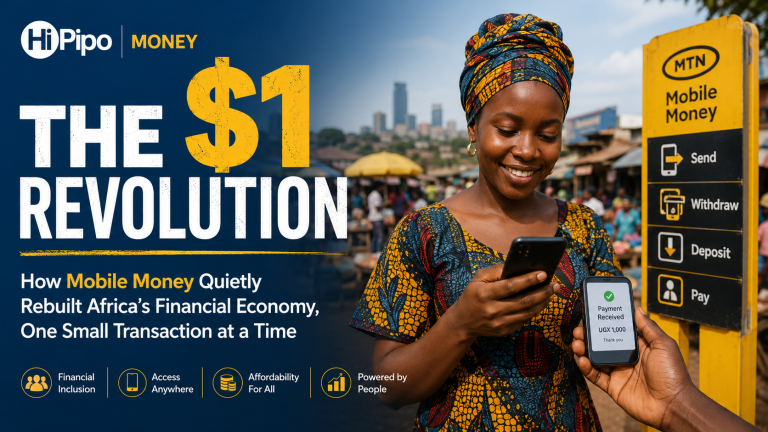
By HiPipo Money
The African digital finance revolution did not begin in skyscrapers.
It began in markets. In villages. In roadside kiosks. In taxi parks.
In small shops where people needed to send the equivalent of one dollar quickly, safely, and affordably.
For decades, millions of Africans operated almost entirely outside formal financial systems. Traditional banks often remained physically distant, expensive, documentation-heavy, and poorly designed for low-income populations and informal economies. Opening an account could require paperwork many citizens did not possess. Maintaining balances carried costs many households could not sustain. And for rural communities, simply reaching a bank branch could consume an entire day.
Yet even outside formal banking systems, economic activity never stopped.
People still traded.
Still saved.
Still borrowed.
Still sent money home.
Still paid school fees.
Still supported relatives.
Still built informal businesses.
The problem was never a lack of economic participation.
The problem was infrastructure. Mobile money changed that. And in doing so, it may have become one of the most important financial innovations of the modern African economy.
Across the continent, mobile money transformed ordinary phones into financial access points. Suddenly, people no longer needed a nearby bank branch to send or receive money. Transactions that once required travel, paperwork, intermediaries, or risky cash movement could now happen digitally within seconds.
The impact was revolutionary not because the transactions were large.
But because they were small. Very small.
Historically, traditional financial systems struggled to serve low-value transactions profitably. Banks were designed around larger balances, formal employment structures, and urban customers. Processing tiny transactions often cost more than the revenue generated from them.
Mobile money changed the economics completely.
By leveraging telecom infrastructure, agent networks, and simple mobile interfaces, providers dramatically reduced the cost of moving money. This allowed millions of low-income users to participate in digital finance for the first time.
A vegetable vendor could receive payment instantly.
A boda boda rider could save small daily earnings digitally.
A parent could send school fees remotely.
A rural family could receive emergency support immediately.
A trader could transact without carrying large amounts of cash.
This is one of mobile money’s greatest achievements:
It made tiny transactions economically viable.
And in Africa’s largely informal economies, tiny transactions collectively power entire communities.
The scale of the transformation became extraordinary.
Sub-Saharan Africa emerged as the global centre of mobile money adoption. According to World Bank-related reporting, approximately 28% of adults in the region had a mobile money account by 2022. In several countries, mobile money penetration surpassed traditional banking penetration entirely.
This fundamentally altered Africa’s financial landscape.
For many citizens, their first meaningful financial account was not a bank account.
It was a mobile wallet.
That shift carried enormous economic implications.
Mobile money reduced transaction costs, increased transaction speed, expanded financial access, improved household resilience, enabled digital commerce, and strengthened informal business activity. It also accelerated broader digital transformation by introducing millions of people to digital financial behaviour for the first time.
The importance of cost reduction cannot be overstated.
Low-income populations are disproportionately affected by transaction friction. A small transfer fee may appear insignificant to upper-income users, but for households surviving on thin margins, transaction costs directly affect survival decisions. Mobile money’s ability to reduce transfer costs and eliminate unnecessary travel created real economic efficiency for millions.
In many rural communities, mobile money became more than a payment tool.
It became financial infrastructure.
Agent networks extended financial access into areas where banks had never meaningfully operated. Informal merchants evolved into cash-in and cash-out points. Small businesses integrated mobile transactions into daily commerce. Governments increasingly distributed social support digitally. Employers digitized wage payments. Families developed new patterns of saving and emergency support.
The technology quietly reshaped economic behaviour itself.
Yet despite its remarkable success, mobile money’s evolution also exposed deeper structural inequalities that remain unresolved.
The first is geography.
Urban users often benefited earlier and more fully from digital finance expansion. Cities generally offered stronger network coverage, denser agent ecosystems, more merchants accepting digital payments, greater smartphone adoption, and higher digital literacy levels.
Rural communities frequently experienced a different reality.
Network instability, lower agent liquidity, long distances between agents, limited merchant ecosystems, and poor digital literacy continued limiting active usage in many regions. In some rural economies, users still rely heavily on cash-out behaviour rather than broader digital ecosystem participation.
This matters because access alone does not equal inclusion.
A rural user may technically own a mobile wallet while still facing significant barriers to meaningful participation in digital commerce.
The second major gap is gender.
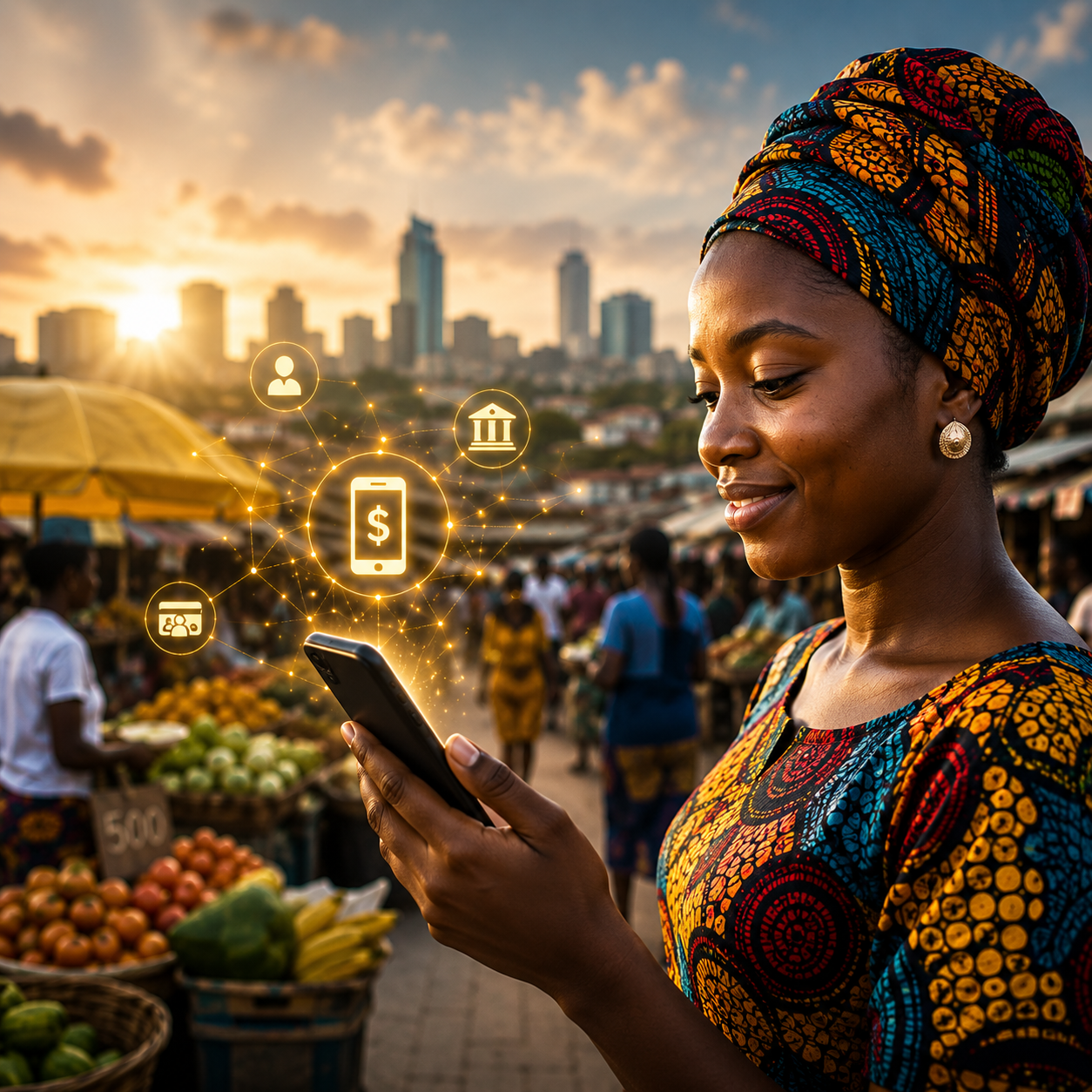
Mobile money significantly improved women’s financial inclusion across Africa. According to World Bank-related reporting, women’s account ownership in sub-Saharan Africa nearly doubled between 2011 and 2021, driven substantially by mobile money expansion.
But major disparities remain.
Women are still more likely to face:
- lower phone ownership,
- lower digital literacy,
- identification barriers,
- affordability challenges,
- social restrictions,
- and reduced confidence using digital financial systems independently.
In several communities, women may have nominal access to accounts but remain dependent on agents, spouses, relatives, or intermediaries to transact. This weakens the empowerment potential of digital finance.
The distinction is critical.
True financial inclusion is not only about account ownership.
It is about control.
Can women transact independently?
Can they save privately?
Can they build transaction histories?
Can they access credit?
Can they participate confidently in digital commerce?
These questions increasingly define the next stage of Africa’s mobile money evolution.
There are also emerging competitive pressures shaping the sector.
Mobile money initially succeeded because it solved a foundational infrastructure problem ignored by traditional banking systems. But the ecosystem is now evolving rapidly. FinTechs, banks, payment gateways, merchant platforms, digital lenders, and cross-border payment providers are increasingly competing within the same financial space.
Mobile money operators are no longer simply telecom services.
They are becoming broader financial ecosystems.
Many now integrate:
- merchant payments,
- lending,
- savings,
- insurance,
- remittances,
- APIs,
- and e-commerce functionality.
This convergence is transforming mobile money from a transfer service into a digital economic platform.
At the same time, regulators face increasingly complex responsibilities. As mobile money ecosystems grow larger and more interconnected, issues around interoperability, taxation, consumer protection, cybersecurity, fraud prevention, data governance, and competition policy become more important.
Trust remains central to the sector’s future.
Financial fraud, scams, SIM swap attacks, social engineering, and digital theft continue threatening confidence in digital finance systems. For low-income users, losing even small amounts of money can create devastating consequences. Strengthening consumer protection and cybersecurity therefore becomes essential for sustaining adoption.
The next phase of mobile money’s growth may ultimately depend on moving users beyond basic transfers into broader economic participation.
Can mobile money help SMEs formalize?
Can transaction histories support lending?
Can cross-border interoperability support regional trade?
Can mobile wallets connect to digital identities?
Can platforms support women entrepreneurs more effectively?
Can rural users participate in digital marketplaces?
Can small-value transactions become gateways into broader financial health?
These questions increasingly shape the future of digital finance policy across Africa.
This is where institutions such as HiPipo and initiatives including the Digital Impact Awards Africa (DIAA), Include Everyone, Women in FinTech, and broader financial literacy programs become strategically important. As digital finance ecosystems evolve, Africa needs platforms capable of not only celebrating innovation, but also examining inclusion gaps, promoting responsible growth, and ensuring digital transformation remains connected to ordinary people.
Because the real story of mobile money is not only technological.
It is deeply human.
It is the story of how millions of small transactions quietly reshaped a continent.
A grandmother receiving support instantly.
A trader avoiding dangerous cash travel.
A student paying school fees digitally.
A woman controlling her own income for the first time.
A small merchant surviving through faster payments.
A rural household entering the formal economy.
Most revolutions are remembered through dramatic moments.
Africa’s mobile money revolution may ultimately be remembered differently.
As millions of tiny moments. Tiny transfers. Tiny payments. Tiny savings. Tiny transactions.
That collectively became one of the largest financial transformations the continent has ever seen.
And in many ways, the future of Africa’s digital economy is still being built one small transaction at a time.