By HiPipo Money
For decades, millions of African women lived outside the formal financial system.
Not because they lacked economic activity. Not because they lacked discipline or ambition.
But because access itself was designed around systems many women could not easily reach.
Traditional banking often depended on:
- physical branches,
- formal employment,
- minimum balances,
- paperwork,
- long travel distances,
- and documentation many low-income women did not possess.
Across rural Africa, especially, financial exclusion became deeply connected to geography, poverty, infrastructure gaps, and social inequality. Women traded daily, ran households, operated microbusinesses, supported families, and participated heavily in informal economies, yet remained largely invisible to formal finance.
Then mobile money arrived. And quietly, one of the most important financial inclusion shifts in modern African history began unfolding.
Over the last decade, women’s account ownership across sub-Saharan Africa has risen dramatically, driven heavily by mobile money adoption and expanding digital financial access. According to the World Bank’s Global Findex database, women’s account ownership in the region grew from roughly 23% in 2011 to approximately 49% by 2021.
The numbers tell a powerful story. But the human transformation behind them is even bigger.
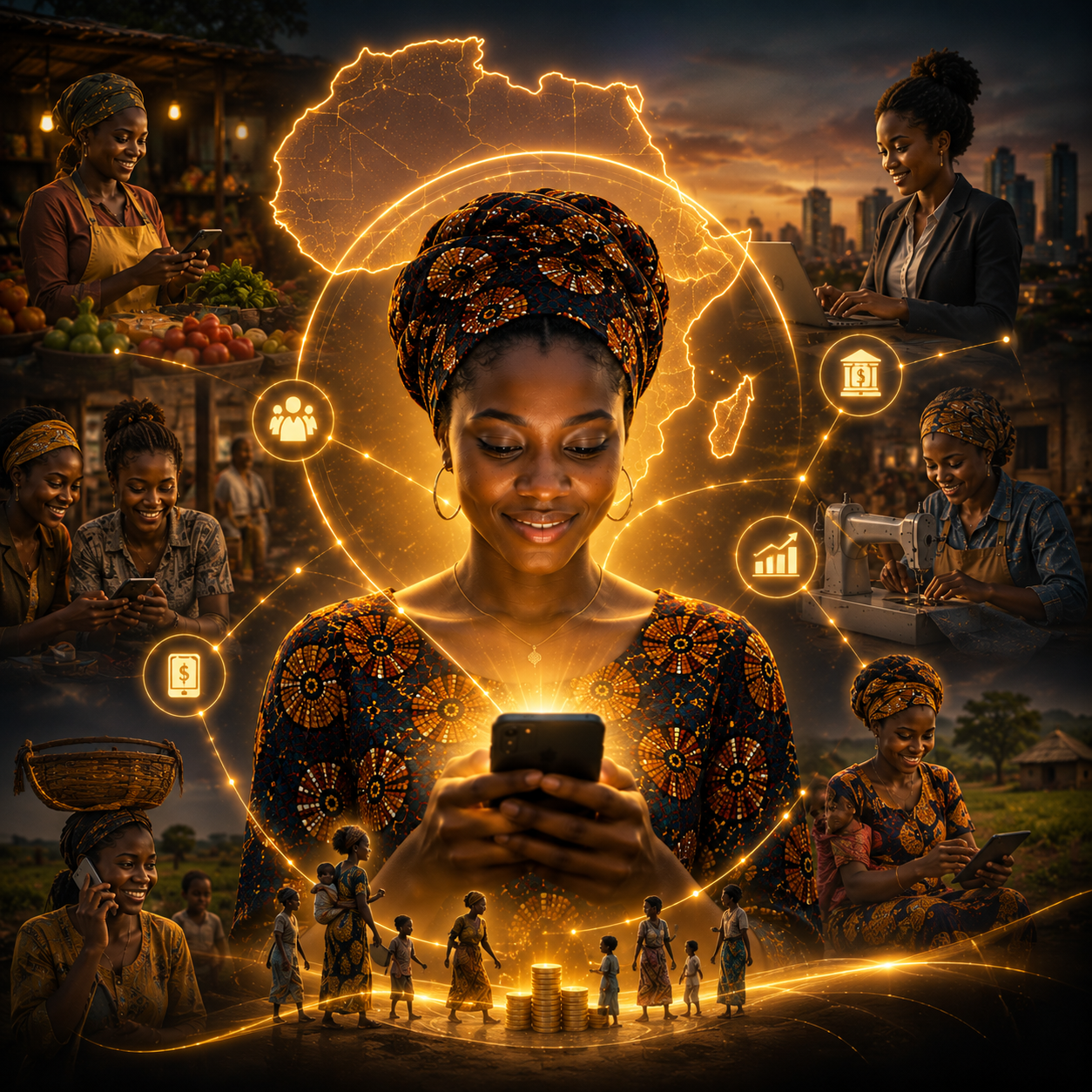
For millions of women, the mobile phone quietly became the first real gateway into formal financial participation.
A market vendor could suddenly receive payments digitally instead of relying entirely on cash. A mother could save privately on her phone without needing to travel to a bank branch. A small trader could separate household money from business income more effectively. A rural entrepreneur could transact across distances that traditional financial infrastructure had failed to serve affordably.
The significance went far beyond convenience. Financial access changes power.
A woman with direct control over a digital account often gains greater independence over:
- savings,
- emergency spending,
- school fees,
- healthcare decisions,
- and small-business management.
This is one reason women’s financial inclusion increasingly sits at the centre of broader development conversations globally. When women gain reliable financial tools, the impact often extends beyond the individual account holder into entire households and communities.
Education outcomes improve.
Household resilience strengthens.
Small businesses stabilise.
Healthcare access becomes easier.
Emergency coping capacity increases.
The multiplier effects can be profound.
Africa’s mobile-first financial ecosystem accelerated this transformation faster than many expected. Platforms such as M-Pesa, MTN MoMo, Airtel Money, and rapidly expanding FinTech ecosystems succeeded because they adapted to realities traditional banking often struggled with. Mobile money worked for:
- small-value transactions,
- informal income flows,
- rural accessibility,
- flexible usage patterns,
- and low-cost participation.
This mattered enormously for women operating within informal and microeconomic environments. Many could join digital finance ecosystems without needing the formal structures traditional banking systems historically demanded.
The phone became the bank branch. And the agent network became the infrastructure layer that made inclusion physically possible.
But the transformation also revealed something deeper about Africa’s digital economy:
Inclusion scales faster when infrastructure adapts to people rather than forcing people to adapt to infrastructure.
That lesson now shapes much of the continent’s wider digital transformation agenda. Yet despite extraordinary progress, major gender gaps remain. Millions of African women still face barriers linked to:
- smartphone affordability,
- internet access,
- digital literacy,
- identification requirements,
- and social restrictions around technology ownership or usage.
In some communities, women remain less likely than men to own smartphones independently. Even where mobile money access exists, deeper gaps often remain around:
- digital savings,
- insurance,
- investment products,
- formal credit access,
- and advanced digital financial services.
Access alone is not enough. Usage matters.
An account that exists but is rarely used does not fully translate into empowerment. This is why the next phase of inclusion increasingly focuses on active financial participation rather than simple account ownership.
Digital literacy has therefore become increasingly important. Many first-generation digital finance users still require support understanding:
- fraud protection,
- PIN security,
- digital savings,
- responsible borrowing,
- mobile lending risks,
- and transaction verification.
Women are often disproportionately exposed to scams or financial misinformation because digital confidence gaps remain significant in many markets.
This means the future of inclusion depends not only on infrastructure, but also on education and trust.
At the same time, women are increasingly shaping the FinTech ecosystem itself. Across Africa, more women are emerging as:
- FinTech founders,
- ecosystem leaders,
- mobile money agents,
- digital entrepreneurs,
- and financial inclusion advocates.
That shift matters because inclusive systems are usually designed more effectively when women participate directly in building them.
The future of digital finance cannot be fully inclusive if women remain underrepresented inside the institutions shaping that future.
There is also a major economic story unfolding beneath the surface.
Women’s financial inclusion may represent one of Africa’s largest untapped growth opportunities. As millions of women gain transaction histories, digital identities, payment access, and financial visibility, they become easier for lenders, insurers, marketplaces, and digital commerce platforms to serve formally.
Inclusion, therefore, expands not only participation, but economic possibility.
A woman operating informally today may eventually:
- access digital credit,
- scale a microbusiness,
- transact regionally,
- build savings,
- access insurance,
- or participate in digital commerce ecosystems previously beyond reach.
This is where financial inclusion evolves from a social conversation into a productivity conversation.
Governments, development institutions, FinTechs, and telecom operators increasingly recognise this reality. Across Africa, digital inclusion programs now increasingly combine:
- mobile onboarding,
- affordable device access,
- digital literacy,
- interoperable payments,
- agent-network expansion,
- and women-focused financial ecosystems.
The objective is no longer simply to count accounts. It is to create meaningful economic participation.
This is where Digital Public Infrastructure becomes especially important. Strong identity systems, interoperable payment rails, affordable connectivity, and trusted digital ecosystems all help lower barriers for women entering formal digital economies.
Without those rails, inclusion slows. Without trust, adoption weakens. Without affordability, participation narrows.
For HiPipo Money, the rise of women’s financial inclusion represents one of the most important economic transformations happening quietly across Africa today.
The continent’s mobile money revolution did more than digitise payments.
It changed who gets to participate in the economy.
This aligns strongly with broader conversations around:
- financial inclusion,
- women’s empowerment,
- digital literacy,
- FinTech innovation,
- interoperable payments,
- and inclusive growth championed through ecosystems such as Women in FinTech, Include Everyone, the Digital Impact Awards Africa (DIAA), and wider digital transformation movements across the continent.
Because ultimately, financial inclusion is not just about technology.
It is about visibility.
A woman saving securely for the first time.
A mother receiving payments directly.
A trader growing a business digitally.
A rural entrepreneur joining formal commerce.
A young woman gaining financial independence through a phone in her hand.
Most people will remember mobile money as a FinTech success story.
But for millions of African women, it became something much bigger.
A doorway into economic participation itself.