By HiPipo Money
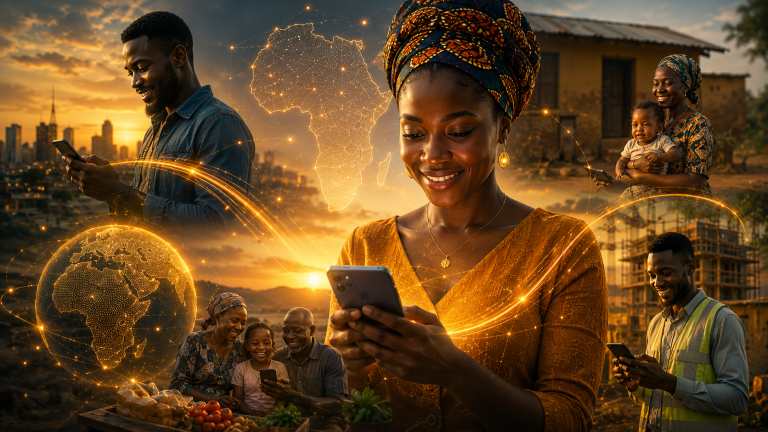
Every evening across Africa, phones light up with messages that quietly sustain entire households.
“Money received.”
For millions of families, those two words mean:
- school fees paid,
- rent secured,
- food purchased,
- hospital bills covered,
- businesses restocked,
- emergencies survived,
- and hope extended for another month.
Behind these transactions lies one of the most powerful and often underestimated, financial systems shaping the African economy:
Remittances.
In 2023, sub-Saharan Africa received approximately US$54 billion in remittance inflows, according to World Bank estimates. Countries such as Nigeria, Ghana, Kenya, and Zimbabwe remained among the continent’s largest recipients, while Uganda received an estimated US$1.4–1.5 billion in diaspora inflows, reinforcing the growing importance of remittances as both a household survival mechanism and a national economic force.
But Africa’s remittance story is changing.
What was once largely a story about migrants sending money home is rapidly becoming a story about digital infrastructure, FinTech innovation, mobile money interoperability, instant payments, cross-border commerce, and the future architecture of African finance itself.
The continent’s remittance economy is no longer simply emotional.
It is strategic. And increasingly, it is digital.
For decades, remittances functioned as Africa’s invisible economic stabiliser.
Long before FinTech became fashionable, diaspora communities quietly supported households across the continent through money transfers that often-bypassed weak formal systems. In many countries, remittances became more reliable than aid flows and more immediate than government interventions.
Families depended on them not as luxury income, but survival income.
A daughter working abroad sends healthcare support home.
A son in Europe pays siblings’ school fees.
A migrant worker supports farming seasons remotely.
A diaspora entrepreneur finances small businesses back home.
These flows became deeply woven into household resilience across Africa.
Yet historically, sending money home was expensive.
Very expensive.
Cross-border transfers into sub-Saharan Africa remain among the costliest globally. Traditional remittance systems often involved:
- high transaction fees,
- multiple intermediaries,
- poor exchange rates,
- settlement delays,
- and limited rural accessibility.
For low-income households, these costs mattered enormously.
A family receiving US$100 may lose a painful percentage before the funds even arrive.
This is why digital finance is becoming transformational.
Mobile money changed the economics of remittances.
Instead of relying entirely on physical collection systems, recipients increasingly gained the ability to receive funds directly into mobile wallets. This reduced travel costs, improved convenience, accelerated settlement, and expanded last-mile access.
The impact was especially significant in rural communities historically underserved by traditional banking systems.
Suddenly, a recipient no longer needed:
- a formal bank account,
- proximity to urban centres,
- or complicated paperwork to access money.
A phone became enough.
This fundamentally expanded financial participation.
It also created one of the most important bridges between remittances and financial inclusion.
Because for many households, remittance-linked wallets became their first meaningful entry point into digital finance ecosystems.
And once users entered digitally, broader possibilities emerged:
- savings,
- merchant payments,
- credit scoring,
- insurance,
- digital commerce,
- and transaction histories.
The remittance itself became the beginning of a larger financial relationship.
Kenya illustrates this transformation powerfully.
The country’s highly developed mobile money ecosystem helped integrate remittances more deeply into everyday digital commerce. Diaspora inflows increasingly move through digital channels that connect directly into merchant ecosystems, savings tools, mobile wallets, and broader financial platforms.
Nigeria, despite infrastructure complexity and foreign exchange pressures, remains one of Africa’s largest remittance destinations due to the sheer scale of its diaspora population and entrepreneurial economy.
Zimbabwe’s remittance dependence reflects another dimension entirely:
economic resilience during prolonged instability.
And Uganda’s growing remittance ecosystem highlights the rising role diaspora inflows play in supporting:
- education,
- healthcare,
- housing,
- SMEs,
- and informal business survival.

In many cases, remittances function almost like decentralized social protection systems.
But the future of remittances is no longer only about household transfers.
It is increasingly about economic infrastructure.
This is where the story becomes much bigger.
Africa’s remittance ecosystem is converging with:
- instant payment systems,
- FinTech APIs,
- mobile interoperability,
- cross-border settlement modernization,
- and digital public infrastructure.
As payment systems modernize, remittances may increasingly move:
- faster,
- cheaper,
- more transparently,
- and more intelligently.
Projects focused on interoperability and real-time payments could significantly reshape how diaspora money flows into African economies over the next decade.
The implications are profound.
Reduced transaction costs mean more money reaches households directly.
Faster settlement improves liquidity.
Interoperability improves accessibility.
Digital records improve visibility.
And integration with local payment systems increases broader economic participation.
This is particularly important for SMEs.
Historically, remittances were often viewed primarily as consumption support. Increasingly, however, diaspora money also funds:
- small businesses,
- construction,
- trade,
- digital entrepreneurship,
- and investment activity.
A diaspora transfer may finance inventory for a market trader.
It may launch a small online business.
It may support agricultural production.
It may help a family transition from survival into enterprise.
The remittance economy is therefore increasingly entrepreneurial.
Yet despite major progress, challenges remain.
One of the biggest is cost.
Sub-Saharan Africa continues to face some of the world’s highest remittance transfer fees. High transaction costs disproportionately affect low-income households sending or receiving small amounts.
Reducing these costs may become one of the continent’s most important financial inclusion victories.
Interoperability remains another challenge.
Fragmented payment systems, disconnected mobile money ecosystems, inconsistent regulation, foreign exchange controls, and differing compliance frameworks continue slowing cross-border efficiency.
In many cases, digital wallets still do not communicate seamlessly across borders.
This creates friction in a continent increasingly pushing toward regional integration under the African Continental Free Trade Area (AfCFTA).
The future digital economy cannot thrive efficiently if moving money across African borders remains expensive and complicated.
Trust also remains central.
Fraud, scams, fake agents, phishing attacks, and cybercrime increasingly threaten confidence in digital remittance ecosystems. For low-income households, losing even small amounts can create devastating consequences.
Consumer protection therefore becomes essential.
Digital remittance systems must be:
- reliable,
- affordable,
- transparent,
- interoperable,
- and secure.
Without trust, adoption weakens quickly.
There is another important shift happening quietly beneath the surface:
Remittances are becoming data.
Historically, much of Africa’s diaspora support moved through informal channels, limiting visibility and financial integration. Digital remittance ecosystems increasingly generate transaction histories that can support:
- savings products,
- lending,
- investment tools,
- insurance,
- and formal financial participation.
The remittance economy is therefore becoming increasingly connected to broader FinTech ecosystems.
This may become one of the most important long-term developments in African finance.
For HiPipo Money, this transformation reflects a deeper truth about Africa’s digital future:
Financial inclusion is no longer only local.
It is global.
The diaspora economy, mobile money revolution, instant payments infrastructure, interoperability frameworks, and FinTech innovation are all converging into a new financial architecture connecting Africa more deeply to itself and to the wider world.
This aligns strongly with broader ecosystem conversations championed through initiatives such as the Digital Impact Awards Africa (DIAA), Include Everyone, Women in FinTech, and wider digital transformation platforms focused on interoperability, inclusion, and cross-border innovation.
Because ultimately, remittances are not just transactions.
They are emotional infrastructure.
Family infrastructure.
Survival infrastructure.
Investment infrastructure.
And increasingly, digital infrastructure.
A mother receiving healthcare support instantly.
A student staying in school because diaspora money arrived on time.
A small trader restocking inventory.
A rural household surviving drought.
A startup launched through family support abroad.
A continent increasingly connected through digital finance.
Most people will never think about remittances as financial architecture.
But quietly, these flows are reshaping African economies every single day.
One transfer at a time.
And if Africa succeeds in modernising its remittance infrastructure fully, the continent’s US$54 billion lifeline may become something even more powerful:
A foundation for the next era of African digital economic growth.