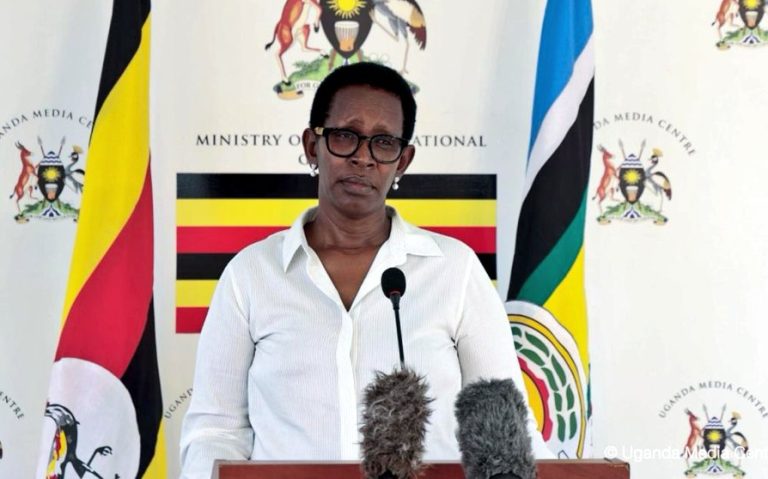
The Ugandan government has announced the temporary closure of its border with the Democratic Republic of Congo (DRC) following growing concerns over the escalating Ebola outbreak in eastern Congo and the increasing risk of cross-border transmission into Uganda.
The decision was announced by the Permanent Secretary in the Ministry of Health, Dr. Diana Atwine, during a media briefing updating the country on the current Ebola situation.
According to Dr. Atwine, Uganda has not registered any new confirmed Ebola Virus Disease (EVD) case since Monday, May 25, 2026. However, health authorities say the number of contacts linked to confirmed patients has continued to rise, with many of them being health workers involved in treatment and response efforts.
The Ministry confirmed that Uganda’s total Ebola cases currently stand at seven, including one death.
In response to the worsening outbreak situation in the DRC, the National Task Force on Ebola Response chaired by Vice President Jessica Alupo resolved to implement stricter containment measures aimed at protecting public health and limiting cross-border transmission.
Under the new directives, Uganda has temporarily closed its border with the DRC with immediate effect.
Government said the only exceptions will apply to authorized Ebola response teams, humanitarian operations, food and cargo transportation, and security personnel operating under strict health screening and monitoring protocols.
The Immigration Authority has also been directed to restrict movement across the border to only authorized personnel and essential services.
All individuals permitted entry into Uganda from the DRC will be subjected to mandatory health screening, documentation, locator form registration, and continuous surveillance in line with Ministry of Health guidelines.
Authorities further announced that any person returning from the DRC into Uganda will undergo mandatory self-isolation for 21 days under the supervision of Ministry of Health surveillance teams and district health authorities.
Despite the heightened restrictions, government confirmed that schools in border districts will remain open but must strictly observe all Ebola prevention Standard Operating Procedures issued by the Ministry of Health.
School administrators have been instructed to identify students returning from the DRC and monitor their temperatures daily for 21 days as part of enhanced surveillance measures.
Districts along the Uganda-DRC border have also been directed to designate at least one health facility capable of isolating and monitoring learners who develop symptoms such as fever during the observation period pending further medical assessment.
The government has additionally instructed all Resident District Commissioners (RDCs) and Resident City Commissioners (RCCs) to strictly enforce Ebola prevention and control guidelines issued by the Ministry of Health and the National Task Force.
As part of intensified public awareness efforts, all media houses across the country have been directed to dedicate at least 30 minutes of prime-time programming daily to Ebola education, prevention, detection, and reporting.
Health officials continue to urge the public to remain calm but vigilant, avoid misinformation, and immediately report suspected Ebola symptoms to the nearest health facility.
Uganda has previously managed several Ebola outbreaks through rapid surveillance, community sensitization, isolation, and contact tracing systems, which health authorities say remain critical in preventing widespread transmission.