By HiPipo Money
For decades, one of the biggest challenges facing many African governments was not simply collecting revenue.
It was tracking it.
Cash-based systems created enormous inefficiencies across public finance. Tax payments could disappear between offices. Manual processes delayed reconciliation. Citizens spent hours in queues to pay licences, permits, and service fees. Corruption opportunities thrived inside fragmented collection systems. Businesses faced uncertainty. Governments struggled with leakages. And public trust weakened when payment systems appeared opaque, inconsistent, or difficult to navigate.
In many cases, the state itself operated slowly because money moved slowly.
Today, that reality is beginning to change.
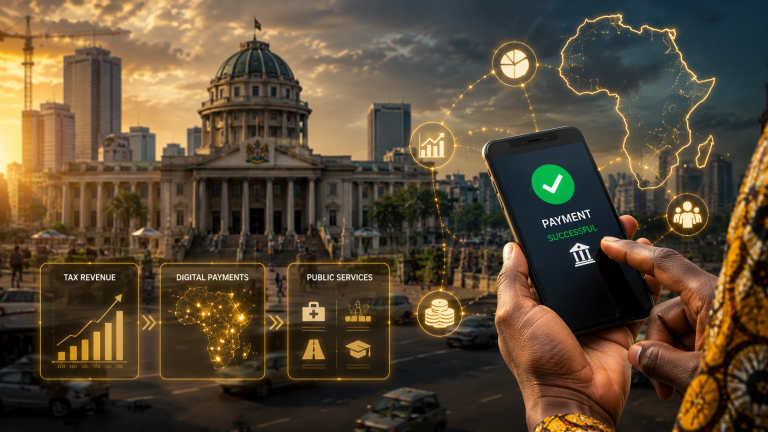
Across Africa, governments are rapidly digitising payments for taxes, licences, utility bills, permits, customs duties, school fees, healthcare services, and public administration charges. Mobile money, digital banking, payment gateways, QR systems, national payment switches, and interoperable digital platforms are increasingly replacing manual cash-based collection systems.
The transformation is not only technological. It is fiscal. Institutional. Political. And deeply economic.
Because when governments modernise payment systems, they do more than collect money faster.
They begin rebuilding the relationship between citizens, businesses, and the state itself.
Historically, public payment systems across many African countries relied heavily on manual processes.
Citizens often needed to:
- travel physically to government offices,
- carry cash,
- fill out paperwork manually,
- wait in long queues,
- and navigate fragmented approval structures.
For businesses, compliance frequently became expensive not only financially, but operationally. A company could lose entire working days processing tax obligations, licence renewals, customs documentation, or regulatory payments.
These inefficiencies created hidden economic costs.
Time lost.
Productivity reduced.
Leakages increased.
Compliance discouraged.
And where manual cash handling dominates, opportunities for informal deductions and corruption often expand.
This is one reason government payment digitalisation has become such a major policy priority across the continent.
Digital systems reduce friction.
And reduced friction improves both compliance and transparency.
At the center of this transformation lies a simple but powerful idea:
When payments become traceable digitally, governance changes.
A digital tax payment creates an audit trail.
A digital licence fee generates real-time records.
A digital customs payment improves visibility.
A digital utility payment reduces cash leakage.
A digital government transfer strengthens accountability.
The transaction itself becomes verifiable data.
This is one of the deepest structural impacts of digital government payments.
Cash systems often obscure visibility.
Digital systems increase visibility.
And visibility changes institutions.
Revenue authorities across Africa are increasingly leveraging digital infrastructure to improve collection efficiency. Tax systems are being integrated with:
- mobile money,
- banking systems,
- payment gateways,
- online portals,
- digital identities,
- and real-time reconciliation tools.
This allows governments to:
- automate collections,
- reduce manual intervention,
- improve compliance tracking,
- strengthen reporting,
- and expand revenue bases more efficiently.
The effects can be substantial.
When payment systems become easier and more transparent, compliance often improves. Citizens and businesses are more likely to pay when systems are:
- convenient,
- predictable,
- accessible,
- and trusted.
This is especially important for SMEs and informal businesses.
Historically, many small businesses avoided formal systems partly because compliance processes themselves were too burdensome. Digital payments simplify onboarding into formal economic participation.
A business owner can:
- pay taxes remotely,
- renew licences digitally,
- verify receipts instantly,
- and reduce costly administrative delays.
This lowers the operational cost of formalisation.
Mobile money has played a particularly important role in this transformation.
Across Africa, telecom-led financial infrastructure often reached citizens faster than traditional banking systems. Governments increasingly recognized that if mobile wallets already handled millions of daily transactions, they could also support:
- tax payments,
- utility collections,
- permit fees,
- school payments,
- transport levies,
- and broader public service transactions.
This dramatically expanded government payment reach.
Citizens no longer needed to rely exclusively on urban offices or bank branches to interact financially with the state.
The implications for inclusion are significant.
A rural trader can renew a licence digitally.
A farmer can pay fees remotely.
A student can pay school charges through mobile channels.
A business can settle obligations without travelling physically.
Digitalisation therefore reduces not only financial friction, but geographic friction too.

Governments are also increasingly connecting payment digitalisation to broader national digital transformation agendas.
Payment systems now intersect directly with:
- digital identity programs,
- e-government services,
- customs modernisation,
- smart cities,
- procurement systems,
- and social protection infrastructure.
This creates what many policymakers increasingly describe as digital public infrastructure.
The idea is simple but transformative:
Identity.
Payments.
Data systems.
Public services.
All connected.
When these systems work together effectively, governments gain stronger administrative capacity and citizens experience more seamless service delivery.
Yet despite the benefits, digitalisation also introduces difficult challenges.
One of the biggest is exclusion risk.
Not all citizens access digital systems equally.
Rural communities may face:
- weak connectivity,
- unreliable electricity,
- low digital literacy,
- and limited smartphone access.
Older populations may struggle with digital interfaces.
Low-income citizens may remain dependent on cash.
Women may face device access barriers.
People with disabilities may encounter inaccessible systems.
A fully digital government system that ignores these realities risks creating new forms of exclusion.
This is why hybrid approaches remain important.
Digital transformation must increase access, not reduce it.
Governments therefore need:
- strong agent networks,
- offline-compatible systems,
- multilingual support,
- consumer education,
- and accessible user experiences.
The goal should not simply be digitisation.
The goal should be inclusive digitisation.
Cybersecurity is another major concern.
As government revenue systems become increasingly digital, they also become more attractive targets for:
- fraud,
- phishing,
- cyberattacks,
- identity theft,
- and system manipulation.
Trust becomes critical.
Citizens must believe:
- payments are secure,
- receipts are legitimate,
- data is protected,
- and systems are reliable.
Without trust, users may revert to informal or cash-based alternatives.
This means payment modernization must be accompanied by:
- strong cybersecurity frameworks,
- transparent governance,
- dispute resolution systems,
- and effective regulatory oversight.
There is another deeper consequence of digital government payments:
They change the visibility of the economy itself.
Digital transactions generate data.
Data improves economic mapping.
Economic mapping improves policy planning.
Governments gain better understanding of:
- business activity,
- sector participation,
- regional trends,
- revenue flows,
- and service demand patterns.
This can strengthen:
- fiscal planning,
- infrastructure investment,
- public service targeting,
- and economic policy design.
In this sense, payment digitalisation becomes state capacity infrastructure.
The long-term implications for transparency are especially important.
One of the strongest arguments for government payment digitalisation is its ability to reduce leakage and corruption opportunities associated with cash-heavy systems. Automated reconciliation, digital records, transaction visibility, and reduced manual handling all improve accountability.
But technology alone is not enough.
Digital systems can improve transparency, if governance remains strong.
Without institutional integrity, even digital systems can be manipulated through procurement abuse, opaque contracts, weak oversight, or exclusionary practices.
Technology, therefore, amplifies governance quality rather than replacing it.
For HiPipo Money, this transformation reflects one of the most important realities of Africa’s digital future:
Financial infrastructure is governance infrastructure.
The modernisation of public payments affects:
- business competitiveness,
- citizen trust,
- SME growth,
- public accountability,
- and national development capacity.
This aligns strongly with broader ecosystem conversations around digital transformation, inclusion, financial literacy, interoperability, and public-private collaboration championed through initiatives such as the Digital Impact Awards Africa (DIAA), Include Everyone, and wider innovation ecosystems across the continent.
Because ultimately, government payment digitalisation is not only about making it easier to pay taxes.
It is about building more efficient states.
A business spending less time in queues.
A citizen receiving transparent receipts.
A rural entrepreneur accessing government services remotely.
A government reducing leakages.
A country improving revenue collection fairly.
A public system becoming more accountable.
Most citizens may never think deeply about the infrastructure behind a digital licence payment or online tax receipt.
But these systems quietly shape how economies function.
And across Africa, the shift from cash-heavy government systems to digital public payments may become one of the most important institutional transformations of the digital age.
Because in the end, modern economies are not only built by collecting revenue.
They are built by collecting trust.