For generations, Down syndrome has been one of the most widely recognised genetic conditions in the world. Caused by an extra copy of chromosome 21, the condition affects millions of individuals and families worldwide. While advances in healthcare, education, and social support have dramatically improved the quality of life for people living with Down syndrome, the underlying genetic cause has remained beyond the reach of modern medicine.
That reality may now be beginning to change.
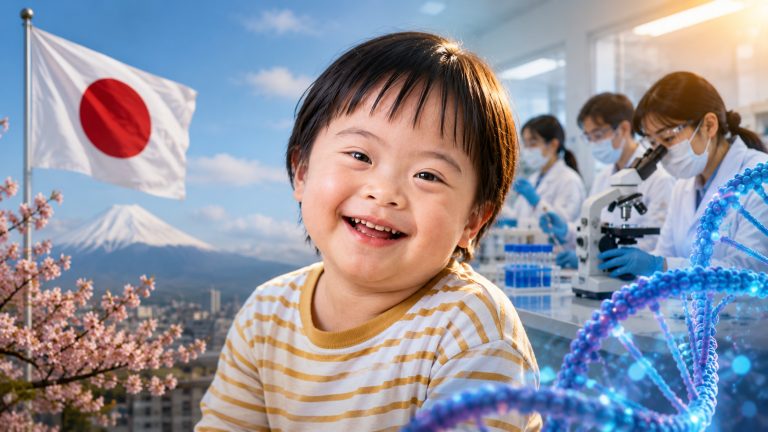
Japanese researchers have achieved a remarkable scientific milestone by successfully removing the extra chromosome associated with Down syndrome from human cells in a laboratory setting. Using advanced CRISPR-Cas9 gene-editing technology, scientists were able to selectively target and eliminate the additional copy of chromosome 21, restoring many cellular functions to normal levels. While the research remains at an early experimental stage and is far from becoming a clinical treatment, it represents one of the most significant advances ever made in the field of chromosomal genetics.
The announcement quickly attracted global attention because it challenges a long-held assumption in medicine: that chromosomal conditions could only be managed rather than corrected. For decades, healthcare professionals have focused on helping individuals with Down syndrome live healthy, productive, and fulfilling lives through therapy, education, family support, and medical interventions. The Japanese breakthrough suggests that future generations of medicine may one day address certain chromosomal conditions at their biological source.
The significance of this research extends far beyond Down syndrome itself. It signals the arrival of a new era in which medicine may increasingly focus on correcting genetic causes rather than simply treating symptoms. For centuries, healthcare has largely revolved around responding to disease after it appears. The future envisioned by researchers is one in which conditions can be identified earlier, understood more deeply, and potentially addressed at the molecular level before they become lifelong challenges.
This transformation is particularly important because it demonstrates how rapidly science is advancing. Technologies such as gene editing, artificial intelligence, genomic sequencing, and precision medicine are converging to create possibilities that would have sounded like science fiction only a decade ago. The ability to target an entire extra chromosome was once considered impossible. Today, it has become a reality inside a research laboratory.
For Africa, the implications are especially profound. While many of the world’s most advanced genetic discoveries emerge from research institutions in countries such as Japan, the United States, Germany, and the United Kingdom, the benefits of those discoveries must eventually reach families everywhere. Across Africa, millions of people live with genetic conditions, developmental disorders, and chronic illnesses that are often diagnosed late or not diagnosed at all. Limited access to specialists, long travel distances, healthcare workforce shortages, and gaps in awareness continue to create barriers for patients and families seeking care.
This is where the conversation moves beyond scientific discovery and toward health inclusion. A breakthrough in a laboratory does not automatically improve lives. A discovery only becomes meaningful when it reaches the people who need it. The greatest challenge of the next generation of healthcare may not be inventing new treatments; it may be ensuring equitable access to them.
Digital health solutions are becoming increasingly important in addressing this challenge. As healthcare systems around the world embrace telemedicine, digital records, artificial intelligence, and remote consultations, access barriers that once seemed insurmountable are beginning to disappear. A parent living hundreds of kilometres away from a specialist can increasingly receive guidance, consultations, referrals, and support through digital channels. The smartphone is rapidly becoming one of the most important healthcare tools in human history.
This is why platforms such as My Doctor are strategically important for Africa’s future. As scientific advances accelerate, digital health ecosystems will play a critical role in ensuring that innovation reaches ordinary people rather than remaining confined to hospitals, universities, and research laboratories. Through telemedicine, remote healthcare access, digital consultations, and AI-enabled healthcare support, platforms like My Doctor are helping build the infrastructure necessary to connect patients with healthcare professionals regardless of geography.
The parallel with Africa’s financial inclusion journey is impossible to ignore. Twenty years ago, millions of Africans were excluded from formal financial systems. Today, digital payments, mobile money, interoperability, and financial technology have connected hundreds of millions of people to once inaccessible services. The same transformation is beginning to unfold in healthcare. Just as digital finance democratized access to money, digital health has the potential to democratize access to quality healthcare.
However, the future also raises important ethical questions. If gene-editing technologies eventually become safe, effective, and widely available, who will have access to them? How will governments regulate their use? Will they be affordable for ordinary families? How do societies balance innovation with human dignity, inclusion, and ethical responsibility? These questions are likely to shape healthcare policy discussions for decades to come.
Researchers themselves caution that the Japanese breakthrough should not be misunderstood. Down syndrome has not been cured. No approved treatment currently exists based on this research. Significant scientific, clinical, regulatory, and ethical hurdles remain before such technology could ever be used in humans. Nevertheless, the achievement represents an extraordinary proof of concept and a glimpse into what future medicine may look like.
Ultimately, the biggest story is not simply about Down syndrome. It is about humanity’s growing ability to understand and influence the biological foundations of health and disease. It is about the convergence of genetics, artificial intelligence, digital health, and precision medicine. Most importantly, it is about ensuring that the benefits of these advances reach every community, every family, and every individual, regardless of where they live.
The future of healthcare will belong not only to those who make scientific discoveries, but also to those who build the systems that deliver those discoveries to the last mile. In Africa, digital health platforms such as My Doctor represent an important part of that future, helping bridge the gap between innovation and impact, between breakthrough and access, and ultimately between possibility and reality.