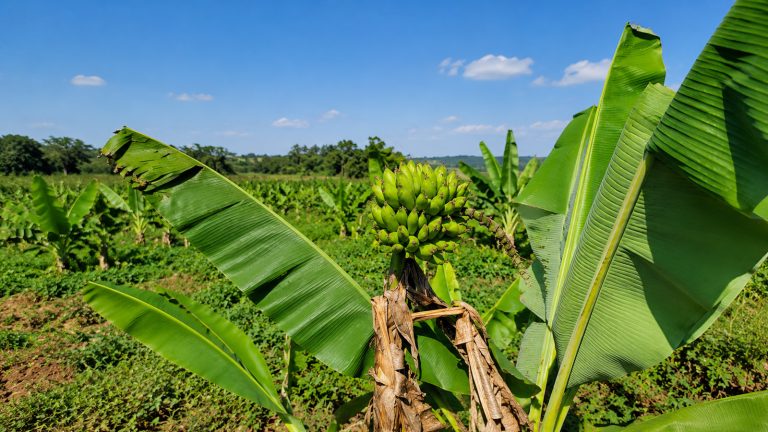
Somewhere in the countryside, beneath the quiet Ugandan sky, a banana plant stood carrying what many farmers would call a disappointment. A tiny bunch. Too small for the months of waiting. Too small for the labor invested. Too small for the expectations carried into the season. And yet, there it was, alive. Growing. Trying. Producing something, even when it could not produce what was expected.
Then came the caption that turned an ordinary farm photo into something deeply human.
“Oba enkumbi emaze nerimba?!”
(“Has the hoe started lying to us?”)
The question, humorously asked by Afande Emilian Kayima, a senior officer in the Uganda Police Force, carries the emotional weight of thousands of farmers, hustlers, entrepreneurs, and ordinary people trying to survive difficult seasons. It was funny at first glance, but beneath the humor sat a truth many people rarely say aloud: sometimes life genuinely feels like the hoe lied.
You plant with hope. You water with sacrifice. You wait with faith. But when harvest time comes, the results sometimes look nothing like the dreams you carried into the season.
And that reality is not limited to farming alone.
It is business. It is investment. It is savings. It is employment. It is entrepreneurship. It is life itself.
Across Africa, millions of people wake up every day believing that hard work alone guarantees predictable outcomes. But nature does not always obey effort. Markets do not always reward sacrifice immediately. Seasons do not always favor the prepared. And financial journeys rarely move in straight lines.
A farmer may cultivate an entire plantation beautifully, only for one stem to produce a painfully small bunch. Another may lose an entire season to drought, pests, disease, counterfeit farm inputs, poor timing, or unstable markets. Yet strangely, the same plantation can still contain healthy plants nearby. That is the painful and beautiful truth about life and money: not every failure means total failure.
Sometimes one plant struggles while the garden survives.
Sometimes one business collapses while the entrepreneur learns enough to build another.
Sometimes one investment disappoints while the rest of the portfolio keeps moving.
Sometimes one year breaks your heart while your future is still quietly growing underground.
That small banana bunch in the picture is more than agriculture. It is a metaphor for expectation versus reality. And in financial literacy, this lesson matters deeply.
Many people enter farming, business, SACCOs, side hustles, savings groups, digital investments, or entrepreneurship believing every season will multiply exactly as planned. Social media has made success look instant, smooth, glamorous, and guaranteed. But real wealth creation is emotional. It is seasonal. It is uncertain. It is unpredictable.
There are seasons when the harvest embarrasses you. Seasons when people laugh at your effort. Seasons when your returns cannot even repay the energy you invested. And still, the wisest farmers do not abandon the land because of one weak stem.
Instead, they study the soil. They inspect the roots. They improve spacing. They check disease management. They learn about water retention. They seek advice. They adapt.
That is what financial literacy truly is: the ability to respond wisely when outcomes do not match expectations.
Because financially mature people understand something powerful: a bad outcome is information, not always the end.
Maybe the soil lacked nutrients. Maybe rainfall patterns changed. Maybe pests attacked silently underground. Maybe the sucker was weak from the beginning. Maybe the timing of weeding was delayed. Or maybe nature simply reminded humanity that control is never absolute.
The same applies to money.
A failed business is not always proof that the entrepreneur is foolish. A poor investment return is not always proof that effort is useless. A delayed breakthrough is not always proof that dreams are invalid.
Sometimes the “small bunch” becomes the lesson that protects the future plantation.
And perhaps that is what makes this image emotionally powerful. Even in its imperfection, the banana plant still produced something. Small. Unexpected. Almost laughable. But alive.
That matters.
Because many people quit before anything appears at all.
The farmer who continues despite disappointment understands resilience better than the person who only celebrates perfect harvests.
Across rural Africa, this story repeats itself daily. A fisherman returns with fewer fish than expected. A trader sells only half the stock. A boda rider works all day and remains with almost nothing after fuel and debt. A mother plants maize and harvests losses because the rains shifted. A graduate applies for hundreds of jobs and receives silence. And yet millions continue waking up again the next morning.
That persistence is one of Africa’s greatest invisible economic assets.
Not perfection.
Not certainty.
Persistence.
The ability to continue cultivating even after disappointment. The ability to keep planting after loss. The ability to believe another season can still produce abundance.
And maybe that is why the question, *“Oba enkumbi emaze nerimba?!”* feels so relatable. Because sometimes the tools we trusted appear to betray us. The market betrays us. The season betrays us. The projections betray us. The promises betray us. Even our own calculations betray us.
But the deeper lesson is this: one small bunch does not define the plantation. One failed season does not define the farmer. One loss does not define the future.
In fact, many experienced farmers will tell you something important: the strongest plantations are often built by people who survived terrible seasons and learned from them.
Financial wisdom grows the same way.
Not merely from profits.
But from survival.
From adjustment.
From patience.
From understanding risk.
From accepting uncertainty without surrendering vision.
And perhaps that tiny banana bunch, standing awkwardly in the middle of a green plantation, is teaching a lesson larger than itself: that life does not always produce according to our expectations. But even imperfect outcomes can still carry seeds of hope. Even disappointing harvests can still feed wisdom. Even difficult seasons can still prepare greater ones ahead.
The hoe may sometimes appear to lie.
But the land still speaks.
And those who continue listening, learning, planting, adapting, and moving forward are often the ones who eventually harvest abundance beyond imagination.