By HiPipo Money
Africa’s FinTech revolution is often described through the language of scale.
Millions of users. Billions in transactions. Rapid mobile money adoption. Explosive startup growth.
But beneath the numbers, another quieter transformation is taking place across the continent.
A growing generation of FinTech companies is building specifically for women entrepreneurs.
Not as a side market.
Not as a symbolic inclusion strategy.
But because millions of African women have historically been underserved by traditional financial systems despite being central to local economies.
Across Africa, women run market stalls, farms, tailoring businesses, food enterprises, transport operations, retail shops, savings groups, beauty businesses, and informal trade networks that support millions of households every day.
Yet many still struggle accessing affordable credit, insurance, savings tools, and formal financial systems designed around the realities of their lives.
Traditional banking often failed to understand how women actually manage money. FinTechs are beginning to change that. One of the most important shifts has emerged through digital savings groups.
Long before FinTech became fashionable, women across Africa had already built powerful informal financial systems through:
- village savings groups,
- rotating savings circles,
- community lending structures,
- and collective contribution networks.
These systems survived because they were trusted, flexible, social, and deeply connected to local realities.
Women used them to:
- save gradually,
- access emergency support,
- fund businesses,
- pay school fees,
- and build resilience in environments where formal banking often remained inaccessible.
But these systems also faced limitations. Cash handling created risk. Records were difficult to track. Remote participation remained difficult. Scaling beyond local communities was limited. Digital finance is now modernising many of these traditional systems.
Women’s savings groups increasingly use mobile platforms to save digitally, track contributions, distribute loans, manage records, and move money securely through phones instead of relying entirely on physical cash systems.
The significance goes far beyond convenience. These platforms are blending something powerful: Traditional community trust with modern financial infrastructure.
For many women entrepreneurs, digital savings ecosystems become the first real pathway into formal financial participation. A woman contributing small amounts consistently through digital savings tools gradually builds:
- transaction history,
- financial visibility,
- and digital confidence.
Over time, that visibility can help unlock access to broader financial opportunities.
A trader previously invisible to formal systems may eventually qualify for:
- working capital,
- merchant services,
- insurance,
- or digital credit products.
The phone becomes more than a payment tool. It becomes a financial identity layer.
Microinsurance is becoming another major area of innovation.
Historically, insurance products across much of Africa were often inaccessible to low-income women entrepreneurs. Premiums felt too expensive. Enrollment processes were too formal. Distribution systems rarely reached informal business owners effectively.
Yet women operating microbusinesses face enormous vulnerability. Illness. Climate shocks. Inventory loss. Crop failure. Household emergencies. One unexpected disruption can destroy years of progress.
Digital microinsurance platforms are beginning to address this gap through:
- low-cost coverage,
- mobile onboarding,
- flexible premium structures,
- and simplified claims systems
designed around informal economic realities.
This matters enormously because resilience is just as important as growth in low-income entrepreneurial environments.
A woman entrepreneur who can recover after crisis is far more likely to sustain long-term economic mobility. FinTechs are also rethinking credit itself.
Traditional lending systems often relied heavily on:
- collateral,
- formal employment,
- fixed salaries,
- and conventional credit histories.
But millions of African women entrepreneurs operate active businesses outside those structures every day.
FinTech platforms increasingly use:
- transaction patterns,
- mobile money history,
- savings behavior,
- merchant payments,
- and alternative financial data
to assess reliability and creditworthiness.
This creates opportunities for women historically excluded from formal lending systems.
A trader once considered “unbankable” may now access working capital because her transaction behavior demonstrates financial discipline digitally.
That shift is transformative.
There is another important change happening quietly beneath the surface.
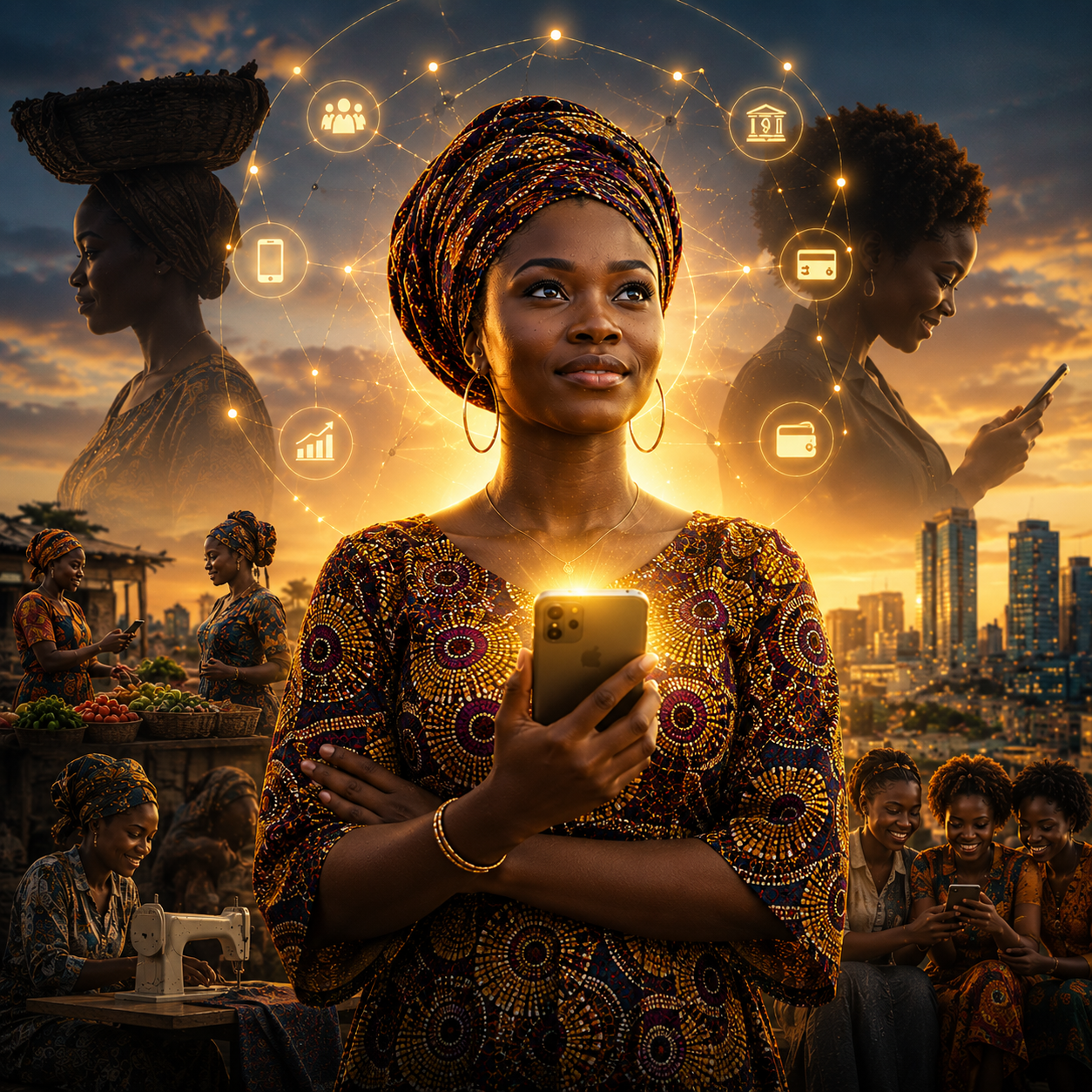
Women are increasingly building the FinTech ecosystem itself.
Across Africa, more women are emerging as:
- FinTech founders,
- digital finance executives,
- mobile money agents,
- ecosystem leaders,
- and innovation advocates.
That representation matters because financial systems become more inclusive when women help design them directly.
Products shaped around actual user realities tend to solve problems more effectively than systems built around assumptions.
The future of African FinTech will likely become stronger as women move from being primarily users of digital finance into becoming architects of digital finance itself.
The rise of women-focused FinTech ecosystems also reflects a broader shift happening within African digital finance.
The conversation is moving beyond:
“How many people have accounts?”
Toward:
“How meaningfully are people participating economically?”
That distinction matters enormously.
A woman may technically own a mobile wallet while still struggling to access:
- business financing,
- insurance,
- savings products,
- or growth infrastructure.
True inclusion requires systems designed around actual economic realities, not simply digital onboarding numbers.
This is why many women-focused FinTech ecosystems increasingly combine:
- financial literacy,
- community savings,
- mobile payments,
- insurance,
- entrepreneurship support,
- and digital education
into broader financial ecosystems rather than isolated products.
The strongest platforms increasingly behave less like standalone apps and more like economic infrastructure.
Yet major challenges remain.
Millions of women still face:
- smartphone affordability barriers,
- digital literacy gaps,
- fraud risks,
- connectivity challenges,
- and limited financial confidence.
Women-led FinTechs themselves often struggle accessing:
- venture funding,
- institutional visibility,
- growth capital,
- and regulatory support.
The ecosystem is growing rapidly, but unevenly. Still, the momentum is becoming increasingly difficult to ignore. Governments, investors, telecom operators, development institutions, and innovation ecosystems increasingly recognise that women are not peripheral participants in Africa’s digital economy.
They are central growth drivers. And FinTechs designed around women’s realities may unlock one of the continent’s largest untapped economic opportunities. There is also a broader macroeconomic story unfolding beneath the surface.
Women already drive enormous portions of:
- informal trade,
- agriculture,
- household spending,
- microenterprise activity,
- and caregiving economies across Africa.
When women entrepreneurs gain stronger financial tools, the effects ripple across households, communities, education systems, and local commerce networks.
Productivity improves. Resilience strengthens. Economic participation deepens. This is why women-focused FinTech innovation is no longer simply a gender conversation. It is an economic growth conversation.
For HiPipo Money, the rise of women-focused FinTechs represents one of the most important transformations shaping Africa’s digital finance future.
The continent’s FinTech revolution is becoming more powerful not simply because more technology exists, but because the technology is increasingly adapting to real human realities.
This aligns strongly with broader conversations around:
- women’s empowerment,
- financial inclusion,
- digital literacy,
- mobile money,
- microfinance,
- entrepreneurship,
- and inclusive innovation championed through ecosystems such as Women in FinTech, Include Everyone, the Digital Impact Awards Africa (DIAA), and wider digital transformation movements across Africa.
Because ultimately, the future of digital finance is not only about scaling transactions. It is about expanding opportunity. A woman saving through a digital group for the first time. A trader accessing working capital digitally. A mother protecting her business through microinsurance. A rural entrepreneur building financial visibility. A FinTech founder designing systems she once needed herself. Most people still think of FinTech mainly as technology.
But across Africa, some of the most important FinTech innovation is becoming something much deeper: Infrastructure for women’s economic resilience, visibility, and growth itself.