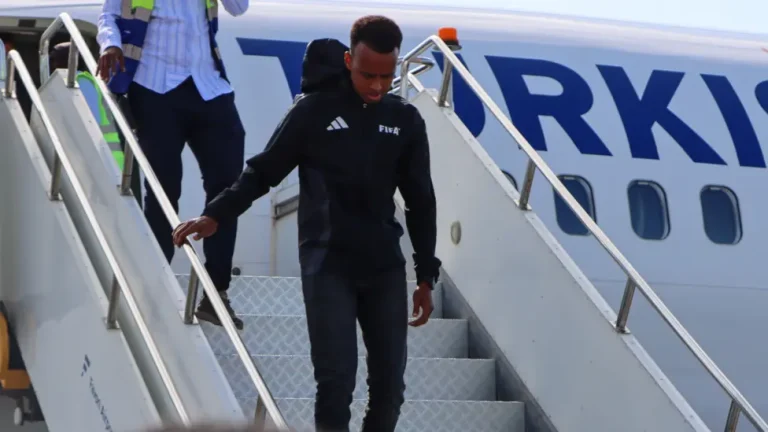
Somali referee Omar Artan was denied entry to the United States because of his “association with suspected members of terror organisations,” a US official has claimed, ending the 34-year-old’s dream of becoming the first Somali to officiate at a World Cup finals.
Artan, named Africa’s Referee of the Year in 2025, was set to be one of 52 referees selected for the 2026 World Cup. But his journey came to an abrupt halt on Monday when he was detained at Miami International Airport, subjected to an 11-hour immigration interview, and put on a flight to Istanbul.
Despite holding a diplomatic passport and a single-entry US visa, Artan was refused admission. Somalia is among twelve countries on a travel ban list introduced by President Donald Trump.
A Trump administration source provided the official justification for the ban.
“This individual was seeking admission to the United States,” the source said. “Upon further inspection by CBP [Custom and Border Protection], derogatory information, including association with suspected members of terror organisations, was discovered making the traveller ineligible for admission to the United States under the Immigration and Nationality Act (INA).”
The source added: “President Trump’s administration will not allow any security threat to enter our country – full stop.”
Artan told the New York Times that during his questioning, border officials asked him about his links to Somali militant group Al Shabab. He said he told them he knew nothing about the group.
It was not possible for Artan to stay outside the United States and referee matches played in Canada or Mexico, as all on-pitch officials were based in Florida for training, preparation, and security. His World Cup dream, he later said, had “crashed down.”
Upon landing at Aden Adde International Airport in Mogadishu on Wednesday, Artan received a hero’s welcome. He was greeted by government officials, representatives of the Somali Football Federation, fellow referees, and local residents.
He later met President Hassan Sheikh Mohamud at the Presidential Palace and is expected to attend a public event at Mogadishu Stadium.
In a brief statement to the media at the airport, Artan spoke of his determination to officiate at the 2030 World Cup but did not take questions from journalists.
“Everything is pre-destined,” he said.” FIFA supported me well and were in touch with me until I reached Mogadishu. I promise you that I’ll be officiating at the next World Cup.”
Artan used his return to issue a defiant message to his country’s young people, urging them not to lose hope in the face of his treatment.
“Let’s all defend Somalia’s honour,” he said. “We all belong to Somalia, whether it’s bad or good. That flag is ours, and so is the passport – let’s defend it.”
He added: “The youth shouldn’t be demoralised about their country. Despite this happening to me, I’ll still stand for my nation. I want to continue my journey from here and urge the youth to do the same.”
President Trump placed a full entry ban under any visa category for twelve countries, including Somalia, in June 2025. Two days before the World Cup draw in December 2025, Trump drew widespread attention for comments made about Somalia in the lead-up to a planned immigration enforcement operation in Minnesota, which has a large Somali community.
“With Somalia, which is barely a country, you know, they have no anything,” Trump said at the time. “They just run around killing each other. There’s no structure.”
He added that Somali immigrants should “go back to where they came from” and that the US would “go the wrong way if we keep taking in garbage to our country.”
Artan’s exclusion raises questions about the intersection of sports and geopolitics. FIFA, world football’s governing body, has not issued a detailed statement on the matter, though Artan acknowledged that the organisation supported him and remained in contact until he reached Mogadishu.
For Somalia, the incident has become a matter of national pride. A referee who was denied entry to the United States has been embraced at home as a symbol of resilience. For the United States, the administration has made clear that security concerns override any sporting considerations.
Artan, meanwhile, has already set his sights on 2030. Whether he will be allowed to pursue that dream remains uncertain.