Elon Musk has entered a place no human being had officially entered before: the trillion-dollar frontier.
From a reported net worth of about USD 2 billion in 2012 to becoming the world’s first trillionaire in 2026, Musk’s journey is more than a wealth story. It is a story of vision, risk, technology, timing, obsession, and a refusal to accept that the future must arrive slowly.
For HiPipo Money, this moment matters deeply. Not because one man has become richer than nations, but because one man has shown that an idea can grow from impossible to inevitable within a single generation.
Tesla challenged how the world moves. SpaceX challenged how humanity reaches space. Starlink challenged how remote communities connect. Neuralink challenged the limits of human-machine possibility. xAI challenged how intelligence itself may be built, distributed, and governed.
But now that Elon Musk has reached the trillion-dollar mountain, the next question is bigger than money.
What should a trillionaire do next?
For Innocent Kawooya, NIM, CEO of HiPipo, the answer is clear: the next frontier is not only Mars. It is the mother in a border market who still cannot receive safe digital payments. It is the young woman innovator who has the talent but not the capital. It is the rural trader who has a phone but no meaningful access. It is the family that cannot study, work, or trade after sunset because energy poverty still rules their night.
Musk has built machines that reach the stars. HiPipo has spent more than two decades building systems that reach the last mile.
That is where the advice begins.
Dear Elon Musk, the world no longer doubts your ability to build the future. But the future will not be complete until it includes everyone.
HiPipo’s Include Everyone program has worked across Africa to bring women, youth, small businesses, border traders, FinTechs, policymakers, and financial institutions into the same conversation: how do we make digital transformation useful for the people most often left behind?
Through financial inclusion advocacy, women-in-FinTech programs, digital and financial literacy, interoperability advocacy, regional partnerships, and last-mile innovation, HiPipo has learned one powerful truth: technology alone does not change lives. Technology changes lives when trust, affordability, literacy, access, and dignity move with it.
That is the lesson Africa can offer Musk.
The world celebrates rockets, electric cars, artificial intelligence, and satellites. But the greatest technology revolution of this century may be the one that allows a woman selling tomatoes at a border post to receive money safely, save consistently, access credit, pay school fees, insure her family, and grow from survival into prosperity.
That is not small innovation. That is civilization-building.
Musk has advised presidents, governments, investors, engineers, and dreamers. But now, from Africa, HiPipo offers him advice in return: build the next chapter of your legacy around inclusive infrastructure.
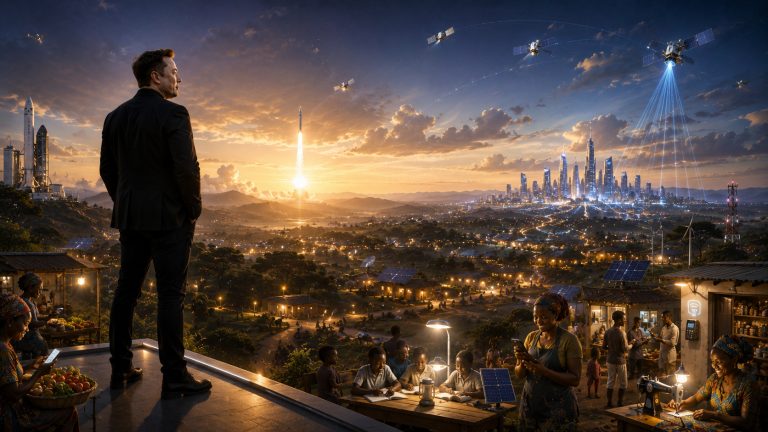
Let Starlink not only connect the world, but deliberately connect the excluded. Let Tesla Energy and solar innovation not only serve premium markets, but power last-mile households, clinics, schools, and micro-enterprises. Let xAI not only compete in intelligence, but help translate knowledge into local languages for farmers, traders, patients, students, and entrepreneurs. Let SpaceX not only take humanity to Mars, but help humanity on Earth reach fairness faster.
Africa does not need pity. Africa needs partnership.
And HiPipo is one of the institutions ready for that partnership.
For years, HiPipo has carried a message that now feels even more urgent: the future must not be designed only by those already inside the system. It must be co-created with those historically locked outside it.
That is why Include Everyone matters. That is why women in FinTech matter. That is why interoperability matters. That is why digital literacy matters. That is why financial inclusion is not charity; it is economic infrastructure.
Elon Musk’s rise from USD 2 billion to over USD 1 trillion proves that exponential growth is real. For African innovators, this is deeply inspiring. It tells us that what looks impossible today can become history tomorrow.
But Africa’s dream is not simply to create one trillionaire. Africa’s dream is to create millions of dignified livelihoods, thousands of scalable enterprises, hundreds of investable platforms, and a generation that no longer sees poverty as destiny.
That is why this moment belongs to Musk, but its meaning belongs to the world.
The trillion-dollar question is no longer: how rich can one man become?
The trillion-dollar question is: how many people can one man help include?
HiPipo’s advice to Elon Musk is therefore simple, emotional, and urgent:
Do not only build the future upward. Build it outward.
Build it to the villages. Build it to the women. Build it to the informal traders. Build it to the schools. Build it to the health centers. Build it to the unbanked. Build it to the young African founder with a world-changing idea but no investor in the room.
Because the next great technology revolution will not be judged only by valuation. It will be judged by inclusion.
And if Musk wants his trillion-dollar legacy to become a humanitarian legacy, Africa is the place to prove it.
HiPipo stands ready.