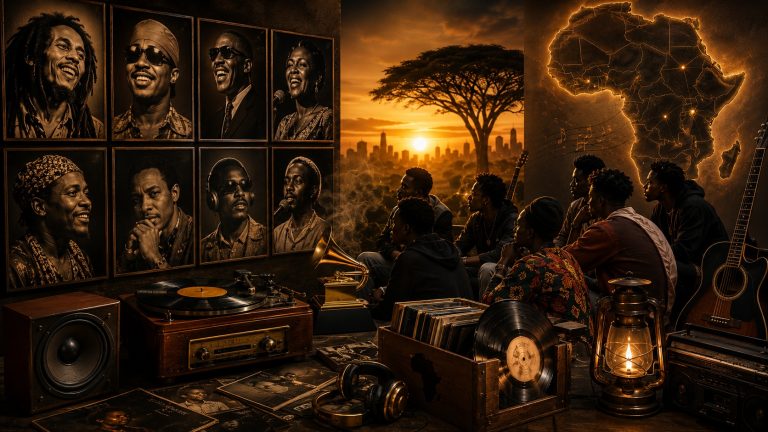
There is something deeply powerful about timeless African music.
Decades pass.
Technologies evolve.
New genres emerge.
New stars dominate headlines.
Entire generations grow up under completely different cultural realities.
Yet somehow, certain African songs continue breathing through time as though they were created yesterday.
That is the mystery and power of true musical greatness.
Across Uganda and the rest of Africa, legendary artists from previous generations continue commanding emotional respect long after their passing. Whether it is the music of Philly Lutaaya, Elly Wamala, Herman Basudde, Paul Kafeero, Jimmy Katumba, Lucky Dube, Miriam Makeba, Fela Kuti, Franco Luambo, Papa Wemba or many others across the continent, one thing becomes undeniable:
Their music survived time.
Their songs still dominate weddings, road trips, bars, radio stations, family gatherings, cultural events, Christmas celebrations, live band performances, and emotional moments across Africa. Younger generations who never witnessed these legends perform live still somehow connect deeply with their music.
That level of longevity cannot happen accidentally.
And it forces an important question upon Africa’s modern music industry:
What exactly did the older generation understand about music that many artists today are slowly forgetting?
Because despite modern studios, advanced software, digital marketing, streaming platforms, artificial intelligence, high-end cameras, and improved production technology, much of today’s music still struggles to achieve the emotional permanence many older African songs achieved decades ago.
Why?
The answer goes deeper than nostalgia.
Many people assume older music feels special simply because societies tend to romanticize the past or respect deceased artists more generously. While nostalgia certainly plays a role, it cannot fully explain why songs from previous generations continue emotionally overpowering newer music in many cases.
The truth is simpler:
Many of Africa’s fallen musical legends were exceptional craftsmen.
They approached music differently.
One of the biggest differences is that many legendary African musicians were not merely recording artists, they were complete musicians.
Most understood music technically.
Most performed extensively.
Many played instruments.
Many studied live performance deeply.
Many understood melody construction, instrumentation, harmony, vocal arrangement, rhythm dynamics, and emotional storytelling from practical experience.
They understood the anatomy of music itself.
That matters enormously.
Today, many artists enter recording studios without understanding basic musical structure. Some cannot identify musical keys. Others depend entirely on producers to shape their songs. Many imitate trending sounds without understanding why those sounds emotionally connect with audiences in the first place.
But older African musicians approached music organically.
Their songs were carefully constructed experiences.
The instrumentation felt intentional.
The melodies felt patient.
The lyrics felt thoughtful.
The emotional delivery felt believable.
The storytelling felt lived.
And perhaps most importantly, the songs carried soul.
Take Philly Lutaaya for example.
Nearly every Christmas season in Uganda and parts of East Africa still reintroduces his Christmas songs to audiences naturally. Decades later, those songs continue feeling emotionally aligned with the spirit of Christmas itself.
Many newer Christmas songs have been released over the years. Some are technically cleaner due to modern production tools. Yet many listeners still emotionally prefer Philly Lutaaya’s originals.
Why?
Because he understood emotional atmosphere.
His songs were not simply seasonal releases.
They carried emotional truth.
That same emotional permanence appears across Africa’s musical legends.
Lucky Dube still emotionally moves audiences decades later because his music addressed humanity, injustice, spirituality, struggle, freedom, pain, and hope in ways that transcended language and borders.
Fela Kuti still feels relevant because his music carried fearless identity, political consciousness, rebellion, and unmistakable originality.
Papa Wemba and Franco Luambo built music rich with rhythm, instrumentation, choreography, elegance, and emotional sophistication that still influences African music today.
Their songs continue surviving because they were built carefully.
And perhaps that is the second major difference between older generations and much of modern African music culture:
They took time.
Today’s entertainment economy rewards speed aggressively. Social media pressures artists to constantly release. Viral culture encourages quick production cycles. Algorithms reward frequency more than refinement.
As a result, many artists now create music hurriedly.
A song is announced today.
Recorded tomorrow.
A video is shot immediately.
The release happens within days.
The pressure to remain visible often produces music that trends briefly but ages quickly.
Timeless music rarely emerges from creative panic.
Africa’s musical legends often spent significant time refining songs. Lyrics were selected carefully. Instrumentation was intentional. Vocal delivery matched emotional context. Arrangements evolved patiently. Songs matured before reaching audiences.
That patience mattered.
Another major difference was motivation.
For many older African musicians, music was first a passion before it became business. They respected the art deeply. They studied performance. They rehearsed extensively. They valued emotional impact. They prioritized craftsmanship before commercial reward.
Today, many artists understandably enter music searching for financial survival, visibility, or escape from poverty. There is nothing wrong with wanting success. The problem begins when financial desperation completely replaces artistic discipline.
That shift changes everything.
Instead of originality, imitation dominates.
Instead of emotional depth, sensationalism dominates.
Instead of mastery, shortcuts dominate.
Instead of storytelling, noise dominates.
The older generation often approached music differently.
They created songs designed to outlive moments.
That is why their music still breathes decades later.
Another overlooked factor is emotional honesty.
Many African legends sounded believable because they sang from lived experience. Their songs carried real struggle, spirituality, heartbreak, joy, wisdom, love, social commentary, humor, and vulnerability.
Audiences trusted them emotionally.
And emotional trust is one of the foundations of timeless music.
People continue replaying songs when they continue finding themselves inside those songs years later.
Ultimately, the greatness of Africa’s fallen musical heroes cannot simply be explained by nostalgia or historical luck.
Their music survived because it was built on powerful foundations:
Passion.
Professionalism.
Technical understanding.
Patience.
Originality.
Emotional honesty.
Respect for the craft.
Those qualities transformed ordinary songs into cultural memory.
And perhaps that is the greatest lesson modern African artists must understand moving forward.
Technology alone will never create timelessness.
Virality alone will never create legacy.
Fame alone will never create emotional permanence.
Timeless music still demands what it has always demanded:
craftsmanship,
discipline,
emotion,
study,
identity,
truth,
and deep respect for the art itself.
Because the songs that survive generations are rarely the loudest.
They are usually the most human.