Home Blog Page 61

Xuldime; promoting e-money in schools, empowering parents monitor children’s performance

By Our Writer

With parents pacing against time juggling a number of things to make ends meet, anything that helps them conclude their children’s school affairs from wherever they are comes in handy.

This is thanks to the emergence of the Financial Technology Companies (FinTechs) that are offering a number of innovative solutions to not only ensure efficiency in service provision but also bring about convenience.

Among them is Xuldime, which provides a digital platform for parents to manage their children’s education expenses, health, academics and other school affairs information, better from wherever they are.

According to the Xuldime Enterprise Leader Laban Jemba, the platform has several capabilities, including helping parents to conveniently pay school fees digitally, using the Xuldime Parents APP or a USSD code by dialing *270*7#.

Xuldime also runs a digital wallet that enables parents to send their children’s pocket money digitally, which is then stored on their wallet smart card to enable them run their shopping at school canteens.

To enable this, the Xuldime system has been integrated with the mobile money platforms –  MTN and Airtel – enabling real-time reflection of funds once it has been deposited on the child’s account. Banks are also now integrating, according to Jemba.

Through the App, parents can also buy scholastic materials for their children and other school needs, from the comfort of their homes or anywhere. To effect this, a parent simply goes to the platform, selects the items they want to buy and pay through the provided platforms.

The items are then delivered to the child at school, who then uses their smart card to authenticate the delivery and receipt of the items.

Additionally, Xuldime also has an attendance and academic performance monitoring solution that enables parents to monitor their children’s school performance.

Its hybrid conferencing and event management platform on the other hand is used by schools to manage their events like school days for people who cannot attend in person to follow. It also helps them disseminate reports and do targeted communication to particular parents.

COVID-19 triggers App upgrade

Jemba says that the outbreak of the COVID-19 pandemic triggered their innovative minds, leading to the upgrade of the attendance application to integrate another App that allows the Ministry of Health and its Education counterpart, with whom it is partnering with for the school-based COVID-19 surveillance, to monitor COVID-19 in schools digitally.

Jemba says this enables schools to comply with the requirement for schools to report any COVID-19 related information daily and also reduces the time they would have spent capturing data manually.

40-Days 40-FinTechs

Xuldime is among the firms participating in the ongoing second edition of the 40-Days 40-FinTechs programme, organized by HiPipo in partnership with Crosslake Technologies, ModusBox and Mojaloop Foundation, and sponsored by the Gates Foundation.

Jemba applauds HiPipo for the programme, saying it shines a light on the innovations in the industry and also exposes them to venture capitalists and other market stakeholders. He adds that it also helps them to peer network better and to peer learn from each other.

The HiPipo Chief Executive Officer Innocent Kawooya says that FinTech is the launchpad on which the promise of full global financial inclusion will be fulfilled.

“The 40-Days 40 FinTechs LevelOneProject shall show we have the innovators to take on the challenges,” he says.

He notes that FinTechs need to be prepared with appropriate products and real time payment systems in place to support an inclusive, interoperable digital marketplace that is both thriving and safe.

To further grow Uganda’s FinTech industry, Jemba appealed to the government to avail more money to the industry for research and more government funded innovation hubs to help to stirrup FinTech innovations to solve existing challenges. 

Xuldime can be accessed on www.xuldime.com

Pegasus continues to bridge the e-money transactions real-time settlement gap

By Our Writer

The delay in settling digital money transactions is among the reasons most people in Uganda prefer cash to electronic transactions.

This explains why Uganda is still a cash economy, with almost 80% of transactions being cash.

However, Pegasus Technologies, a Financial Technology Company (FinTech), continues to oil the shift from cash to cashless by supporting businesses and entities that want to adopt digital payments do so reliably.

The Pegasus Managing Director Ronald Azairwe, says reliability is a key aspect that must be adopted and delivered by industry players if people are to shift from cash.

“For anyone to put their product out there and accept digital payments, one of the things they require is reliability. Cash offers reliability and that is something we need to understand as people in digital payments. When someone pays cash for goods and services, the transaction is completed immediately,” Azairwe says.

He adds: “People want to understand that even in digital transactions, it can happen in real time and if there is any issue, there will be sufficient support to understand what has happened.”

He notes that Pegasus has positioned itself to support anyone that decides to take digital payments by putting out a number of platforms to aid them.

Among them is the ticketing system, which he says helps people that have adopted digital payments trace payments, in case they were untraceable.

Additionally, Pegasus ensures that payment from a customer to a merchant happens in real time, giving them the same assurance that cash does.

Established in 2007, Pegasus has gained prominence in the development of financial solutions for companies, emerging as a leading payment services aggregator in Uganda with vast experience in development, configuration, deployment, support and maintenance of financial and billing solutions for businesses and institutions.

The solutions include bill payment solution, mobile money aggregation, mobile payments and remittances, loans and savings, card payments, software development and value added services such as SMS, airtime and data loading.

Its PegPay payments platform is currently being used by several institutions including banks, telecoms and utility companies, retailers, Pay-Tv providers and schools, to aggregate and manage financial transactions for both internal and external purposes.

Under the mobile money aggregation solution, an organisation is able to collect money through a USSD, mobile application or web application. Organizations are also able to effect payments to their end user beneficiaries, using the Pegasus platform or through their own platforms after being integrated with an API.

Azairwe commends government for the move to regulate electronic money, saying it will boost public confidence to use e-money. He, however, says government needs to recognize e-value as money.

“Currently, there is no law that allows government to recognize e-value as money. You cannot pay a government institution using e-cash and they accept. That money will have to first go to a bank account somewhere before it is recognized,” he says.

He adds: “We need to see digital payments done to government in real time recognized as value and government can re-use that e-value collected to make onward payments. Once that is done, it will go a long way to close the loop.”

He adds that there is also need for more merchants to participate, saying that the more the merchants, the easier it will be for people to adopt digital payments.

“More businesses should close cash offices and opt for digital payments.”

Pegasus is among the FinTechs participating in the ongoing second edition of the 40-Days 40-FinTechs initiatives organised by HiPipo, in partnership with Crosslake Tech, ModusBox and Mojaloop Foundation.

Azairwe commends HiPipo for the initiative, saying it has created awareness about existing solutions in the market.

“You can develop the best thing out there but if people do not know it, they will not use it. This awareness is commendable as it gives us a voice to reach more people. When we started about 15 years ago, there were no such programs and we had to cut our way through the bushes and shrubs. The 40 Days 40 Fintechs initiative is empowering FinTechs which is a step in the right direction.”

The HiPipo Chief Executive Officer, Innocent Kawooya congratulated Pegasus Technology on making 14 years in the industry.

“Pegasus Technologies is among the pioneers in Uganda’s FinTech Industry. Over the last 14 years, they have served and saved millions of customers through their cocktail of products and services. We congratulate them on this milestone.”

He noted that FinTechs need to take advantage of the current COVID-19 challenge to innovate more cashless and real time payment solutions.

“We need to be prepared with appropriate products and have appropriate real time payment systems in place to support an inclusive, interoperable digital marketplace that is both thriving and safe.”

Insure Small Small is using Financial Technology to boost Insurance Penetration

By our writer.

Insurance penetration in Uganda has remained below 2% for a long time, as efforts to increase uptake by traditional players have not yielded much.

This may, however, change as InsurTechs join the market with innovative solutions.

One of the InsurTechs that is helping to set the ball rolling is Insure Small Small – a micro insurance strategy for the “forgotten consumer”.

The Insure Small Small’s founder and CEO, Oscar Ofumbi, says that traditional insurance is broken, evidenced by supplying the same products through different channels, with no regard to innovation or delivery.

This, he adds, has created a forgotten consumer and thus the need to reinvent.

He defines a forgotten consumer as an economically active consumer who has been left out of insurance coverage.

“We hope that by focusing on the forgotten consumer and building user generated demand, we will contribute to the greater ecosystem.”

Ofumbi adds that due to COVID-19 and its economic shocks, access to life saving but high priced essentials like medical insurance has been impacted hence the need to curve out niches attuned to the customer’s need. 

Insure Small Small launched with a micro insurance product for malaria and typhoid dubbed Bomba MED.

This, Ofumbi says, is because statistically, malaria affects 10 million Ugandans, and 23% of Out Patient visits are due to malaria. While the cost for treating malaria is affordable, he says sicknesses strikes when least expected, hence the need for insurance protection.

The Bomba- Dawa plan costs UShs5,000 (USD 1.4) monthly.

How it works 

Ofumbi says that their platform has fused five unlikely verticals into one application across disease diagnosis, treatment, logistics, e-commerce and technology and a user can self-onboard.

“We have built a USSD application *284*89# from which users can self-onboard, buy a policy using mobile money and file a claim. The clinic/pharmacy uses the same USSD code to verify the claim and we make an instant payment to the partner’s wallet via mobile money.”

The InsurTech has also integrated Level One Project best practices, taking advantage of the low cost USSD technology, and weaving it into a futuristic technology, enabling them to programmatically create a USSD-smart contract.

This makes an instant payment upon verification of a claim and since USSD can be accessed on low cost devices, they are thus able to reach the target audience.

Ofumbi notes that InsurTech plays a crucial role, noting that if used rightly, the rich data generated by InsurTechs has potential to positively contribute to financial inclusion through identification of the underserved but potentially profitable niche markets, best served using low cost technology tools.

However, he notes that the InsurTech sector is currently grappling with limited opportunities for strategic partnerships as the indigenous local insurers have zero appetite for innovation while the majority of foreign insurers are filled with decision red tape.

Additionally, the insurance structure presents huge challenges, as InsurTechs are up against incumbents that have deep pockets and reinsurance players that stifle innovation because they refuse to understand innovation which is a new way of doing an old thing.

40-Days 40-FinTechs

Insure Small Small is among the firms participating in the ongoing edition of the 40-Days 40-FinTechs initiative, organized by  HiPipo in partnership with Crosslake Technologies, ModusBox and Mojaloop Foundation, and sponsored by the Gates Foundation.

He commended HiPipo for the initiative, saying it has brought about teamwork and networking, to enable players complement each other.

“There is a saying that if you want to go near go alone, if you want to go far travel with others.”

“This is a perfect initiative and strategically I foresee opportunities for established teams to acquire smaller ones, merge with others or get acquired thus strengthening the ecosystem.”

The HiPipo Chief Executive Officer Innocent Kawooya says through this edition, FinTechs have shown a plethora of solutions, seeking to solve unique sets of challenges.

“Insure Small Small has come up with an e-health product targeting the underserved, who are the majority. It fully runs on USSD which makes it accessible to anyone with a phone. This is a step in the right direction.”

He adds that FinTech is the launchpad on which the promise of full global financial inclusion will be fulfilled.

Club Tangaza is helping children, women develop love for CODING.

By our writer

When you talk about software engineering, many females will tell you that it is a preserve for males.

This is basically because in addition to being a male-dominated field, most females think that software development is a hard discipline and thus should be pursued by men.

To demystify that belief, however, Club Tangaza, an online coding platform for children and beginners, has come out to demonstrate that anyone, be it a young girl, boy, woman or man, can acquire the software development skill and excel at it.

According to the Club Tangaza co-founder Cleopatra Kanyunyuzi, the company set out to teach the young generation (girls and boys), starting at an early age, coding skills so as to develop the love for it early in life instead of being introduced to them while at college or university.

“Coding is currently referred to as the literacy of the 21st century; so it is only imperative that we teach our generation how to code. Learning to code is like learning any other language and these skills need to be taught at an early age before they become picky,” Kanyunyuzi says.

She adds: “In this era of the internet of things (IOT) devises around us are interconnected and they communicate through code. So, these skills are really very important.”

Coding refers to giving a set of instructions to a computer, which instructions are written in a programming or computer language.

Kanyunyuzi says: “Coding is no longer a reserve for software engineering or computer science students, learners do not have to wait to go to college or university to start learning how to code; anyone can learn how to code.”

Club Tangaza runs three programmes including Tangaza Kids for children aged four to 12, Tangaza Def Club (13 years and above) and Team Techy (13 and above).

To enroll, one visits www.clubtangaza.com, and chooses an appropriate programme, after which they are given feedback and a schedule.

Kanyunyuzi, however, says that while at Club Tangaza both boys and girls are exposed to the same tools, environment, equality in assessment and opportunities, enrollment is still higher for males than females. She adds that males also tend to stay committed throughout the entire course than their female counterparts.

Incentives needed

To increase the number of females embracing technology, Kanyunyuzi says there is need for incentives from both the private and public sectors.

“As private Club Tangaza, we provide discounted prices for girls that enroll for our progrmmes but this is not enough because we are just a small entity.

“We thus call upon leading females in Tech and the government to join this cause. The government should probably roll out these programmes in schools so that they are not only left to people who can afford them but even people at the grassroots because there is that young girl or woman who has not even seen a computer but would love to get involved in shaping the technology trends of our country,” she notes.

Club Tangaza is among the firms participating in ongoing second edition of the 40-Days 40-FinTechs initiative organized by HiPipo in partnership with Crosslake Technologies, ModusBox and Mojaloop Foundation, and sponsored by the Gates Foundation.

The initiative provides a platform for FinTechs and stakeholders in the digital and financial technology space to exhibit their products and share ideas.

Kanyunyuzi says the 40-Days 40-FinTechs initiative is championing digital inclusion by shining a light on local startups that are providing digital solutions to automate business processes in the country.

The HiPipo Chief Executive Officer Innocent Kawooya says through this edition, FinTechs have shown a plethora of solutions, seeking to solve unique sets of challenges.

He adds that FinTech is the Launchpad on which the promise of full global financial inclusion will be fulfilled.

KaCyber helping transport operators close revenue leakages

By Our writer

Transport operators lose a lot of revenue as untrustworthy conductors charge money that is not recorded anywhere in the operator’s books, thus revenue leakages.

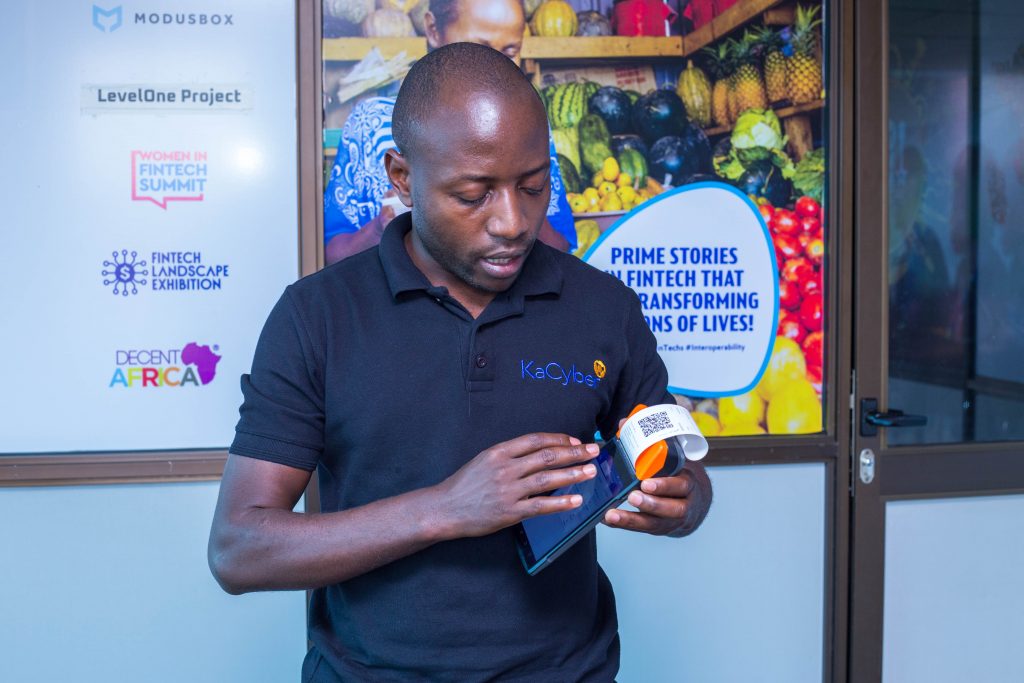
In a bid to close the gap and improve transport operators’ revenue collection, however, Innocent Orikiiriza founded the KaCyber, a transport and logistics technology company that builds digital ticketing and payment systems for transport operators of buses, trains, and ferries.

Orikiiriza says that he was motivated to innovate the online ticketing solution after seeing that Uganda’s transport operators lacked reliable and cost-effective ticketing systems and were losing money due to manual ticketing mechanisms.

“Based on KaCyber’s transport sector survey and data analysis, bus operators lose 30 to 40 per cent of their revenue when using manual booking systems,” Orikiiriza says.

Currently being used by the Uganda Railway Corporation (URC) on the Kampala commuter train and local buses companies including Star Link and Highway Coaches, the solution has blocked revenue leakages and also enables passengers to book a travel ticket online, and only go to the bus or train station on their travel day.

“Our digital platform serves both the transporters and passengers; on the operator side, we provide point of sale machines that allows instant ticket issuance and payment collection, as well as real-time sales reconciliation,” he explains.

He adds: “On the passenger side, we provide a mobile application for Android users and a ticket booking marketplace, where the public is able to book and pay for travel tickets of buses, trains and ferries.”

According to Orikiiriza, the company implements LevelOneProject Principles as it does not compromise when it comes to security implementation in its product ecosystem.

He notes that their products are developed with bank-grade security controls.

“We are lucky to have established strong partnerships with companies that comply with global payment standards at all levels. Our systems are connected to payment processors, banks, and mobile networks,” he says, adding that they are also in discussion with payment schemes and integrators that offer real-time payment settlements.

Cheap exposure

KaCyber is among the firms participating in the ongoing second edition of the 40-Days 40-FinTechs programme, held by HiPipo under its Include EveryOne programme, in partnership with Crosslake Tech, ModusBox and Mojaloop.

Orikiiriza commended HiPipo for the programme, saying it will empower more startups to get cheap exposure to a wide network of potential partners at a local and international scale.

He, however, says that while FinTech industry continues to grow on a global scale, startups in Uganda continue to struggle to bring their solution to market due to low tech adoption and limited resources to break through these barriers.

He notes that collaborations with the banks and telecommunications companies are highly needed now more than ever to create favorable platforms and allow Uganda’s FinTech industry to grow exponentially.

The HiPipo Chief Executive Officer Innocent Kawooya alludes that the second edition of the 40-Days 40 FinTechs will showcase the best of the multitude of solutions and products one can think of in the digital space.

“We expect showcases of innovations and brands operating in this space and also use this chance to learn, at no cost, from probably the most knowledgeable pool of global FinTech experts that are all scheduled to present this year.

Kawooya adds that FinTech in Africa offers attractive opportunities and that investors are rightfully picking interest in the various startups that are offering a plethora of services, ranging from payments and lending, remittances, cross-border transfers and neobanks, among others.

KaCyber can be accessed at www.kacyber.com and on social media

YTIB Capital is bridging Blockchain usage gap through SMS

By Our writer

While not many people in Uganda and across the African continent are using the Blockchain technology mainly due to its complexity, YTIB Capital is helping simplify it so as to increase usage.

Through its SMS to Blockchain and API service, YTIB seeks to bring the ordinary person into the bracket of Blockchain users so as to impact their lives meaningfully.

According to Michael Katerega, the founder and Team Leader at YTIB Capital, Blockchain is currently only impacting society mostly on the high end, leaving out the last mile person.

“We are seeking to bridge that gap between the people who are supposed to use it; that person in the village, and the person at the high end of development,” Katerega says.

YTIB Capital is a financial markets software company that deals in several software initiatives, especially for financial markets in Africa.

Despite its immense potential, Katerega says the Blockchain technology is misunderstood by communities, especially given that most people mistake it for Crypto Currencies which have been used to defraud people.

“A lot of people think that Crypto Currencies is blockchain, which is not true. Blockchain is separate technology and Crypto Currency is just a product that comes on top of the Blockchain technology,” he says.

He adds: “Blockchain has a lot of potential that is why we came up with an SMS to blockchain platform whereby we are trying to put the power of Blockchain in the hands of as many people as possible by incorporating with SMS.”

Katerega notes that through the SMS, YTIB Capital is slowly bridging the gap.

“We get the SMS part and combine it with Blockchain so that people can access the power of Blockchain without realizing it. Someone can store their records. They can transfer ownership of an asset using an SMS and a binding document will be created electronically to allow the transfer. All that is a potential we are giving out to the people using Blockchain network,” Katerega explains.

He adds: “If you have a phone that uses SMS, you can send a query request to a server, or a network and you get certain responses that are not common to daily users of SMS. With that, you can query the capabilities of what is happening on the Blockchain and then have them incorporated within your business.”

YTIB also runs Ubuntu FSX; an aggregation software for stock exchanges in Africa.

Katerega, however, expresses concern over the current negative publicity for Blockchain, that resulted from people being scammed through Crypto Currencies.

He notes that there is need to sensitize people about Blockchain and its capabilities and the difference between Blockchain and Crypto Currencies.

He also decries the limited number of Blockchain developers in the country and absence of funding towards Blockchain related projects.

To help build capacity, however, Katerega says that his company, through one of its trading platforms, started a training course for Blockchain, where its clients’ teams are taken through the course to understand how to develop on the Blockchain.

YTIB Capital is among the firms participating in the ongoing 40-Days 40-FinTechs initiative, which is organized by HiPipo in partnership with Crosslake Technologies, ModusBox and Mojaloop Foundation, and sponsored by the Gates Foundation.

The HiPipo Chief Executive Officer Innocent Kawooya alludes that this edition of 40-Days 40 FinTechs is Uganda’s most comprehensive foray into things like distributed ledger technologies, Artificial Intelligence, Big Data, Automated Customer Relationship Management, cash management and lending platforms.

He adds that this edition is showcasing the best of the multitude of solutions and products one can think of in the digital space.