Ugandan musician Master Parrot, popularly known for his hit song Muliro, has died following a tragic road accident along the Northern Bypass in Kampala.
Reports indicate that the singer lost his life after the vehicle he was travelling in was involved in a fatal crash, sending shockwaves through Uganda’s entertainment industry and among his fans.
Details surrounding the accident were still emerging by the time of publication, with authorities expected to release further information as investigations continue.
News of Master Parrot’s death quickly spread across social media, where fellow musicians, fans, and entertainment figures expressed grief and paid tribute to the artist’s contribution to Uganda’s music scene.
Master Parrot rose to prominence through Muliro, a song that became widely popular and helped cement his place among Uganda’s notable entertainers. His music earned him recognition across different audiences, particularly among fans who appreciated his energetic style and distinctive sound.
Over the years, the singer remained a familiar figure in Uganda’s entertainment circles, performing at various events and maintaining a loyal following.
Friends and colleagues described him as a passionate artist whose dedication to music helped him build a lasting connection with fans.
The accident has once again highlighted growing concerns over road safety in Uganda, particularly along major highways and urban road networks where fatal crashes continue to claim lives.
Road safety advocates have repeatedly called for stricter enforcement of traffic regulations, improved driver discipline, and enhanced road infrastructure to reduce the number of accidents across the country.
Master Parrot’s death adds to a list of Ugandan musicians and public figures whose lives have been cut short in road accidents, tragedies that have often reignited national conversations about transport safety.
As news of his passing continues to circulate, tributes have continued pouring in from supporters who remembered him for both his music and his presence within the local entertainment industry.
Family members, friends, and fellow artists are expected to release details regarding funeral arrangements and memorial events in the coming days.
His passing leaves a gap in Uganda’s music community, with many fans remembering him for the songs and performances that defined his career.
For many Ugandans, Master Parrot will be remembered not only as the voice behind Muliro but also as an artist whose music contributed to the country’s vibrant entertainment landscape.
Uganda’s active mobile subscriptions reached 47.5 million in the first quarter of 2026, according to the latest Market Performance Report released by the Uganda Communications Commission (UCC).
The report, which covers January to March 2026, provides a comprehensive snapshot of the country’s communications sector, including subscriptions, traffic and usage, financial performance, postal services, broadcasting, and film.
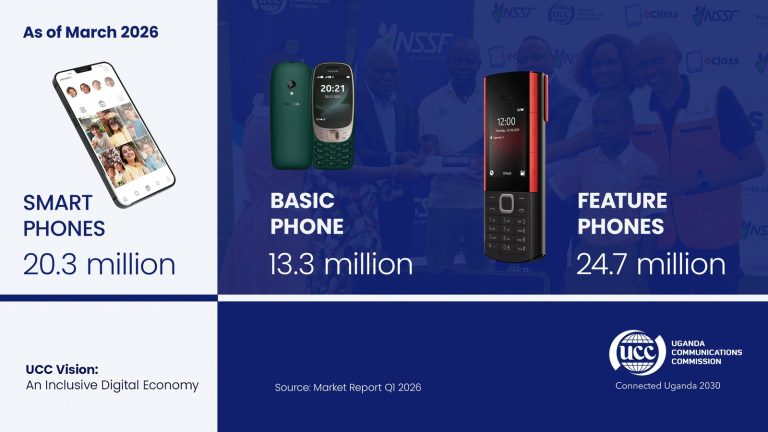
Total active mobile subscriptions stood at 47.5 million, while fixed line subscriptions remained modest at 375,000. The device landscape continues to show a mix of technologies, with 13.3 million basic phones, 24.7 million feature phones, and 20.3 million smartphones still in use.
The report also noted that TikTok had 10.8 million active users in Uganda during the quarter, underscoring the growing appetite for short-form video content in the country.
Ugandans consumed vast amounts of digital content and services between January and March. The report recorded 2.37 billion mobile money transactions, reflecting the continued dominance of mobile financial services in the economy. Data consumption also surged, with 256.8 billion gigabytes downloaded during the quarter.
Voice traffic remained robust, with 20.9 billion domestic on-net minutes, 1.8 billion domestic off-net minutes, and nearly 197 million One Net Area (ONA) inbound minutes. International voice traffic included 13.2 million inbound minutes and 10.7 million outbound minutes.
The report indicated that total industry revenue stood at 1.66 trillion Uganda shillings in December 2025, compared to 1.62 trillion in September 2025 and 1.78 trillion in June 2025. The postal and courier sector also contributed to the overall performance, though specific revenue figures for Q1 2026 were not highlighted.
The postal and courier sector has expanded significantly, growing from 29 licensed operators in 2019 to 56 in 2026. However, the UCC noted that 60 percent of the sector remains unregulated. At the Annual Postal and Courier Engagement Forum held on 6th March 2026, stakeholders discussed challenges including licensing, customs, transport permits, and fee harmonisation. Key actions agreed upon include memoranda of understanding between URA and couriers, eBox rollout, and digital system integration.
Express Mail Service (EMS) recorded 1,638 outbound items and 1,873 inbound items during the quarter.
The broadcasting sector’s activities during the quarter were significantly shaped by the 2026 General Elections. UCC Executive Director Hon. Nyombi Thembo appeared on multiple television and radio platforms, including NBS TV, UBC TV, BBS TV, Sanyuka TV, and radio programmes such as Big Talk on Next Radio and The Spectrum on Radio One. He consistently emphasised media responsibility, cautioned against misinformation and hate speech, and reminded broadcasters that only the Electoral Commission has the authority to announce official results.
In a notable enforcement action, Dean Saava Lubowa, proprietor of unlicensed online broadcaster TV10 – Gano Mazima, was convicted by the Makindye Standards, Utilities and Wildlife Court for operating without a UCC licence. He pleaded guilty to three offences and received cumulative fines or custody, with 45 broadcasting items forfeited.
The UCC continued to nurture Uganda’s film industry during the quarter. The Regional Film Competition (RFC) 2026 ran from 2nd to 27th March across Soroti City, Arua City, Luwero District, and Hoima City. The competition drew 257 national submissions, with the Central region leading at 112, followed by Western (73), Eastern (67), and Northern (64).
Over 1,000 film stakeholders attended market screenings in Soroti, more than 700 in Hoima, and school outreaches reached up to 1,500 students. Eight trainee short films were produced. Digitally, the campaign achieved over 6.4 million impressions and an estimated reach of 1.27 million.
UCC also supported free public community screenings of the documentary Memories of Love Returned, which celebrates the life of renowned Ugandan photographer Kibaate Aloysius Saslongo. The film was directed by Ntare Guma Mbahe Mwine and has received international recognition across five continents.
In the area of digital inclusion, UCC delivered digital skills training to smallholder farmers in Adjumani District, covering topics such as mobile money reversal, online fraud prevention, and access to e-government services. The Commission also launched a nationwide Child Online Protection school outreach, identifying two ICT students per school as COP Ambassadors to promote peer-to-peer education.
UCC supported Uganda’s first bone marrow transplant centre with a contribution of USD 10,000, an initiative aimed at bringing life-saving treatment for sickle cell disease and blood cancers closer to home.
The Commission also announced the restoration of public internet and mobile services after the 2026 General Elections, following a temporary restriction introduced to prevent misinformation and electoral interference.
The Q1 2026 Market Performance Report reflects a sector that continues to grow in both scale and complexity. With mobile subscriptions nearing 48 million, data consumption soaring, and regulatory enforcement intensifying, the UCC has signalled its commitment to balancing growth with consumer protection, security, and accountability.
Uganda’s mobile device landscape continues to evolve. As of March 2026, Uganda recorded 20.3 million smartphones, 24.7 million feature phones, and 13.3 million basic phones.
This surge in mobile devices reflects a brighter future where access to digital services is within… pic.twitter.com/0al5gsileb
For generations, African commerce operated with a hidden tax:
Time.
Businesses waited for payments to clear. Merchants waited for transfers to arrive. Suppliers waited for settlement confirmations. Employees waited for wages. Traders waited for banks to open. Small businesses waited for liquidity.
In traditional financial systems, payment delays were treated as normal.
In the digital economy, they increasingly look obsolete.
Across Africa and the wider world, instant payment systems are rapidly transforming how money moves between individuals, businesses, governments, banks, merchants, and digital wallets. Instead of waiting hours or days for settlement, transactions can now happen almost immediately, twenty-four hours a day, seven days a week.
The implications reach far beyond convenience.
Instant payments are becoming economic infrastructure.
And for Africa’s small businesses especially, speed may increasingly determine survival.
Historically, financial systems were designed around batch processing cycles. Transactions often moved through multiple institutions, settlement windows, and operational checks before funds became fully available. This structure worked reasonably well in slower, branch-based economies.
Money is increasingly expected to move as fast as information itself.
This is why countries across Africa are investing heavily in:
instant payment systems,
real-time settlement infrastructure,
interoperable payment rails,
national switches,
and modern payment gateways.
The goal is not only faster transactions.
It is economic acceleration.
At the center of the instant payments story lies one critical concept: Liquidity.
For large corporations, delayed settlement may create inconvenience.
For small businesses, it can create crisis.
An SME operating on thin margins often depends on rapid cash turnover to survive. A merchant may need same-day liquidity to restock inventory. A small restaurant may require immediate access to sales revenue to buy supplies the next morning. A market trader may depend on fast payments to continue daily operations.
When payments take too long to settle, business momentum slows.
This is why instant payment systems matter so deeply for Africa’s informal and SME-driven economies.
They compress financial waiting time. And in business, reduced waiting time creates economic efficiency. A payment received instantly becomes usable working capital immediately. That changes everything.
Across many African economies, SMEs form the backbone of commerce. Yet these businesses frequently face:
limited access to credit,
weak cash reserves,
inconsistent revenue cycles,
and high operational vulnerability.
Delayed settlement intensifies these pressures.
Instant payments improve liquidity directly by reducing the gap between transaction initiation and fund availability. Businesses can:
restock faster,
pay suppliers sooner,
manage cash flow more predictably,
reduce borrowing dependency,
and operate with greater financial confidence.
For microenterprises and informal traders, this can significantly improve resilience.
In many cases, the difference between same-day settlement and multi-day settlement is not simply operational efficiency.
It is business continuity.
The rise of mobile money helped lay the foundation for this transformation.
Africa’s mobile money revolution introduced millions to near-instant digital transfers long before some traditional banking systems modernized fully. People became accustomed to sending money rapidly through phones, agent networks, and digital wallets.
That behavioural shift changed expectations permanently.
Once consumers experience instant transactions, delayed payments begin feeling increasingly unacceptable.
This is now forcing broader modernization across:
banks,
payment processors,
FinTechs,
governments,
and merchant ecosystems.
Real-time payments are becoming the new benchmark.
The economic impact extends beyond SMEs.
Instant payment systems improve commerce at multiple levels simultaneously.
Consumers gain convenience and confidence. Merchants improve transaction certainty. Governments digitise collections more efficiently. Employers distribute wages faster. Cross-platform commerce expands. E-commerce ecosystems become more viable.
The effects ripple through entire economies.
Importantly, instant payment infrastructure also supports financial formalisation.
When transactions occur digitally and immediately, businesses generate clearer transaction records. Over time, this data can support:
credit scoring,
lending,
taxation efficiency,
inventory financing,
and broader financial participation.
This is one of the hidden strengths of digital payments:
The transaction itself becomes economic data.
And in the modern economy, data increasingly drives access to opportunity.
Africa’s push toward instant payments is also closely connected to interoperability.
A fast payment system has limited value if it operates only within isolated ecosystems. Businesses increasingly need to transact across:
banks,
mobile money providers,
FinTech platforms,
and merchant systems seamlessly.
This is why many countries are investing in national switches and interoperable real-time payment infrastructure capable of connecting multiple financial players.
The broader vision is a connected digital economy where money flows freely regardless of provider.
For SMEs, this reduces friction dramatically.
A merchant should not need multiple wallets for multiple customers. A trader should not struggle because suppliers use different platforms. A customer should not face delays because networks are disconnected.
Interoperability therefore magnifies the economic value of instant payments.
Yet despite their advantages, instant payment systems also introduce new challenges.
The faster money moves, the faster mistakes and fraud can move too.
Cybersecurity becomes more critical. Fraud detection systems must become more intelligent. Dispute resolution frameworks must evolve rapidly. Consumer protection becomes more important. Operational resilience becomes essential.
In traditional systems, delays sometimes created time for manual intervention.
Real-time systems reduce reaction windows dramatically.
This creates pressure for:
stronger digital identity systems,
advanced fraud monitoring,
real-time compliance,
and secure interoperable infrastructure.
Trust, therefore, becomes central.
An instant payment system is only economically valuable if users believe it is:
reliable,
secure,
affordable,
and consistently available.
Network downtime, failed reversals, hidden charges, or fraud incidents can weaken confidence quickly.
Another important challenge is inclusion. Not all users experience instant payments equally.
Urban businesses with smartphones, stable internet, and integrated merchant systems often benefit first. Rural merchants may still face:
network instability,
electricity challenges,
low agent liquidity,
and weaker digital infrastructure.
If modernisation remains uneven, the speed economy could widen existing inequalities rather than reduce them.
This is why instant payment infrastructure must be built inclusively.
Systems designed only for high-end users or large businesses risk excluding the very populations driving much of Africa’s economic activity.
The continent’s informal economy depends heavily on:
small-value transactions,
low-bandwidth systems,
feature phones,
and low-cost payment channels.
The future of instant payments in Africa therefore, depends not only on technological sophistication, but on accessibility.
Globally, instant payments are increasingly viewed as strategic national infrastructure.
Countries modernising payment systems are not merely improving banking operations.
They are increasing economic competitiveness.
Faster payments support:
digital commerce,
entrepreneurship,
innovation,
productivity,
and economic formalisation.
In Africa, where SMEs drive large portions of employment and commerce, the gains could be especially significant.
This is one reason why ecosystem builders such as HiPipo and initiatives including the Digital Impact Awards Africa (DIAA), Include Everyone, Women in FinTech, and broader digital financial inclusion programs remain strategically important. Payment modernization is not simply a technology conversation. It is a business growth conversation, a financial inclusion conversation, and ultimately an economic transformation conversation.
Because behind every instant payment lies something very human:
A business surviving because cash flow arrived on time. A merchant restocking inventory faster. A trader closing more sales confidently. A worker receiving wages immediately. An entrepreneur scaling operations without waiting days for settlement.
Most people may never think about payment rails, settlement engines, or real-time gross settlement systems.
But they will feel their impact.
In faster commerce. Better liquidity. Reduced stress. Expanded opportunity. And economies that increasingly move at the speed of ambition rather than the speed of delay.
Africa’s instant payment revolution is therefore about much more than technology.
More than two decades after his death, the remains of celebrated musician Prince Paul Kafeero have been exhumed to resolve a paternity dispute involving over 20 young people who claim he was their father.
The exhumation took place on Monday morning, marking a critical turning point in a case that has lingered for over 20 years. The dispute, which has drawn significant public attention, involves more than two dozen individuals seeking legal recognition as children of the late singer.
According to officials, the exhumation and sample collection were carried out professionally by a team of pathologists led by Assistant Inspector General of Police Dr. Byaruhanga. The operation followed a court order and adhered to established forensic protocols.
Outgoing Minister for Youth and Children Affairs, Hon. Balaam Barugahara who is preparing to hand over the docket, announced the development as a significant step forward in resolving the prolonged family dispute. The minister, who described himself as a friend of the late Kafeero, has been involved in efforts to address the matter for years.
The DNA samples collected from the remains will now be analyzed at two facilities: the Government Analytical Laboratory and the Uganda Police Forensic Laboratory, which is equipped with state-of-the-art technology. The results are expected to provide conclusive evidence regarding the paternity claims.
Prince Paul Kafeero remains one of Uganda’s most beloved musicians, known for his distinctive voice and iconic songs that continue to resonate with audiences years after his death. His passing left behind not only a musical legacy but also unanswered questions regarding his estate and the children who claim to bear his name.
The paternity dispute has been a source of tension within the family and among the claimants, with no resolution reached for two decades. The exhumation now offers the possibility of scientific closure.
The use of advanced DNA analysis at two separate laboratories is intended to ensure accuracy and credibility, reducing the likelihood of further legal challenges.
If the results confirm the claims of some or all of the over 20 individuals, it could have significant implications for inheritance, family recognition, and the late musician’s estate. Conversely, if the claims are disproven, the matter may finally be laid to rest.
The DNA samples are now being processed. Results are expected to be released once the analysis is complete, though no specific timeline has been provided by the authorities. The court that issued the exhumation order will likely receive the findings and determine the next steps in the legal process.
For the over 20 claimants, many of whom have waited their entire lives for answers, the coming weeks could finally bring the truth.
As I prepare to hand over the Youth and Children Affairs docket soon, I wish to inform the public that the long-standing paternity dispute involving over 20 young people allegedly fathered by my friend, the late Prince Paul Kafeero, will soon be resolved.
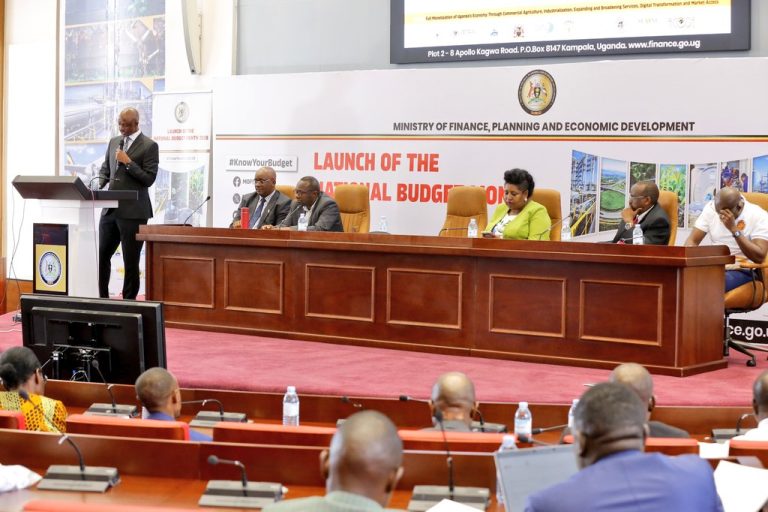
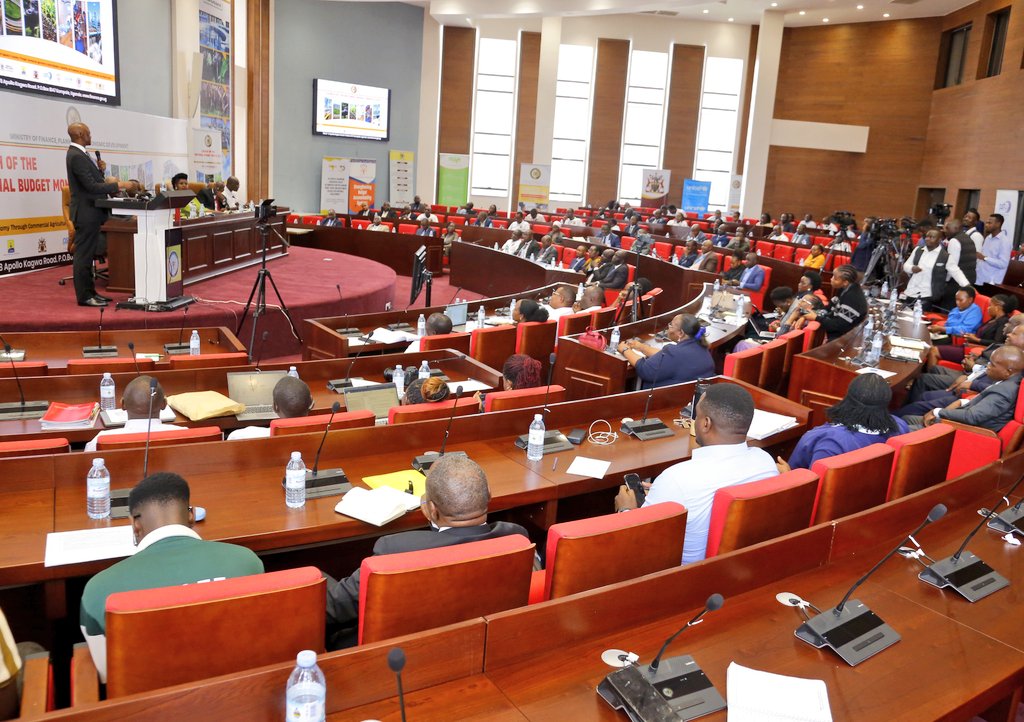
The Ministry of Finance, Planning and Economic Development has officially launched the National Budget Month for Financial Year 2026/27, an initiative aimed at enhancing transparency, accountability, and citizen involvement in the budget process. The launch took place at the Ministry’s Conference Hall in Kampala, where Permanent Secretary and Secretary to the Treasury, Ramathan Ggoobi, underscored the government’s commitment to engaging citizens throughout the budget cycle.
“The success of any budget goes beyond its formulation and depends largely on effective implementation, monitoring and oversight by all stakeholders,” Ggoobi said.
The FY 2026/27 budget was passed by Parliament on 24 April 2026 and is anchored on the theme: “Full Monetization of Uganda’s Economy through Commercial Agriculture, Industrialization, Expanding and Broadening Services, Digital Transformation and Market Access.” According to the Ministry, the budget was developed through an extensive consultative process involving the President, Cabinet, Parliament, local governments, civil society, development partners, the private sector, academia, youth and women groups, persons with disabilities, and ordinary citizens across the country.
First introduced in 2018, the National Budget Month serves as a platform for government to account to citizens on achievements registered during the current financial year, communicate opportunities available in the new budget, and obtain feedback to inform future planning and policy decisions. Activities include budget dialogues, media engagements, publications, social media campaigns, and community outreach initiatives conducted in partnership with civil society organisations and development partners.
Ggoobi noted that the initiative has significantly enhanced public ownership of the national budget and improved Uganda’s performance in international assessments. According to the latest Open Budget Survey, Uganda’s budget transparency score improved from fifty-eight percent in 2021 to fifty-nine percent in 2023, surpassing the global average of forty-five percent. Budget oversight also improved from fifty-nine percent to sixty-seven percent during the same period, well above the global average of fifty-two percent.
However, the Permanent Secretary observed that there is still need to strengthen public participation in the budget process and expressed optimism that ongoing efforts will lead to improved performance in the 2025 Open Budget Survey. He commended budget transparency partners including CSBAG Uganda, ACODE Uganda, UDN, UNICEF Uganda, SEATINI Uganda, the Uganda Revenue Authority, and the Private Sector Foundation Uganda for supporting citizen engagement and budget literacy initiatives across the country.
The Ministry reaffirmed its commitment to sustaining collaboration with stakeholders in promoting openness, transparency and accountability in public finance management. Ggoobi officially launched the National Budget Month activities for FY 2026/27 and called upon all citizens, institutions and development partners to actively participate in the engagements to ensure effective implementation of the national budget and achievement of Uganda’s development aspirations.
NBM LAUNCH FY 2026/27: PSST @rggoobi now launching the National Budget Month for FY 2026/27 at @mofpedU
He says the budget for FY 2026/27 is about ATMS and Enablers to drive Uganda's Tenfold Growth Strategy. pic.twitter.com/fnMP6DiaD7
A narrative exploration of how online tools save time, money and effort for businesses and citizens.
When the Digital Impact Awards Africa first surveyed Uganda’s largest companies in 2015, it discovered that more than half lacked websites. Customers queued for hours and travelled long distances to pay bills or obtain information. Ten years later, the picture is very different. Take Sarah, a shopkeeper in Kampala. She now renews her trade licence online during a lunch break, saving herself a two‑hour trip. Andrew, a farmer in Gulu, sells his beans through a mobile platform and receives payment into his phone wallet within minutes. A small manufacturer in Mbarara uses a web portal to order raw materials and track delivery status.
These individual conveniences add up. Today Uganda’s top taxpayers conduct roughly three million online interactions every day. Each interaction saves about 30 minutes, freeing 1.5 million hours daily and delivering a financial impact of about $1.995 million. Over a decade these digital efficiencies have generated around $7.28 billion in savings. The benefits reach far beyond corporate boardrooms; families spend less on transport and fees, entrepreneurs can focus on growth instead of paperwork, and civil servants process more transactions with fewer errors.
For women and young people the digital leap is particularly empowering. Women in urban areas leverage mobile money and online services to juggle businesses and household responsibilities. Youth use social media to market products and access financial services. As data costs fall and mobile subscriptions rise, these digital pathways could spread to rural and off‑grid areas, unlocking further prosperity.
Uganda’s experience underscores the power of advocacy and collaboration. HiPipo’s Include Everyone programme has championed digital innovation for nearly two decades, pushing businesses and regulators to embrace web platforms, mobile payments and open APIs. Together with telecommunications providers and fintech partners, they have shown that digital tools can lift economies. The next challenge is to ensure that the digital revolution benefits everyone by investing in connectivity, affordable devices and user‑friendly services.
Stories like Sarah’s and Andrew’s reveal how digital tools make everyday life easier and more productive. By focusing on human experiences and quantifiable savings, we see that digital transformation is not an abstract concept but a practical solution to long‑standing inefficiencies. Expanding these benefits to rural communities, women, and youth will be crucial for inclusive economic growth.